
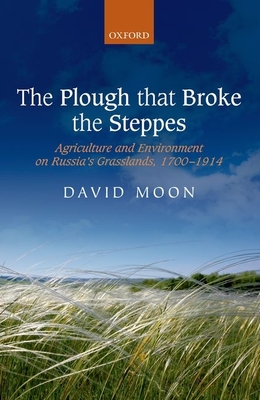
The Plough That Broke the Steppes: Agriculture and Environment on Russia's Grasslands, 1700-1914 - Hardcover
by David Moon
$214.99
Quantity
01
Pay over time for orders over $35.00 with
Offers & Perks
Earn 214 points with this purchase
Added to your rewards balance after checkout.
100 points welcome bonus
Create an account and start with extra points.
Availability:In StockContributor:David MoonSeries:Oxford Studies in Medieval European HistoryTheme:Aspects (Academic)/Historical, Chronological Period/18th Century, Chronological Period/1900-1919, Chronological Period/19th Century, Cultural Region/RussianPublish date:5/5/2013Pages:344
Languages:EnglishPublisher:Oxford University PressISBN-13:9780199556434ISBN-10:0199556431UPC:9780199556434Book Category:HistoryBook Subcategory:Russia, Historical GeographySize:9.30 x 6.10 x 1.10 inchesWeight:0.658Product ID:SC0FAY26FH
This is the first environmental history of Russia's steppes. From the early-eighteenth century, settlers moved to the semi-arid but fertile grasslands from wetter, forested regions in central and northern Russia and Ukraine, and from central Europe. By the late-nineteenth century, they had turned the steppes into the bread basket of the Russian Empire and parts of Europe. But there was another side to this story. The steppe region was hit by recurring droughts, winds from the east whipped up dust storms, the fertile black earth suffered severe erosion, crops failed, and in the worst years there was famine. David Moon analyses how naturalists and scientists came to understand the steppe environment, including the origins of the fertile black earth. He also analyses how scientists tried to understand environmental change, including climate change. Farmers, and the scientists who advised them, tried different ways to deal with the recurring droughts: planting trees, irrigation, and cultivating the soil. More sustainable, however, were techniques of cultivation to retain scarce moisture in the soil. Among the pioneers were Mennonite settlers. Such approaches aimed to work with the environment, rather than trying to change it by planting trees or supplying more water artificially. The story is similar to the Dust Bowl on the Great Plains of the USA, which share a similar environment and environmental history. David Moon places the story of the steppes in the wider context of the environmental history of European colonialism around the globe.
Languages:EnglishPublisher:Oxford University PressISBN-13:9780199556434ISBN-10:0199556431UPC:9780199556434Book Category:HistoryBook Subcategory:Russia, Historical GeographySize:9.30 x 6.10 x 1.10 inchesWeight:0.658Product ID:SC0FAY26FH
David Moon is a specialist on Russian history. In recent years his research has focused on environmental history in a transnational context. He combines conventional historical research in archives and libraries with field work in the environments he studies. He has spent much of his career teaching at universities in the north of England and Scotland. He also has extensive experience of both Russia and the USA. He studied for a year at Leningrad State University in what was then the Soviet Union, and makes regular visits to Russia and Ukraine, including the steppe region, for research and field work.
Publisher: Oxford University Press
Contributor(s)
Author
Free shipping on orders over $75. Standard shipping takes 3-7 business days. Eligible items may be returned within 30 days of delivery. Conditions apply.