
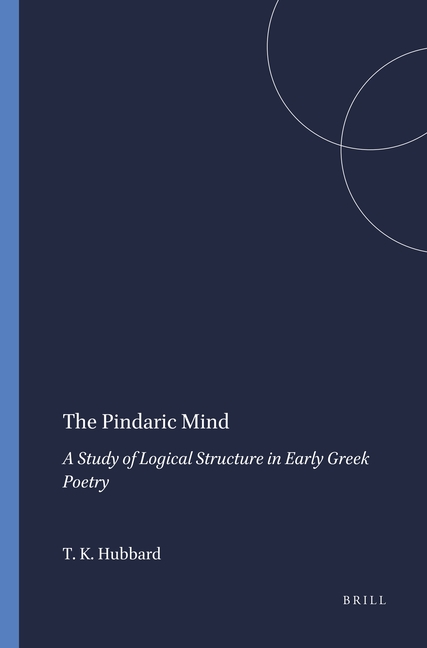
The Pindaric Mind - Paperback
$145.99
$149.00
-2%Quantity
01
Pay over time for orders over $35.00 with
Offers & Perks
Earn 145 points with this purchase
Added to your rewards balance after checkout.
100 points welcome bonus
Create an account and start with extra points.
Availability:In StockContributor:Thomas K. HubbardSeries:Mnemosyne, SupplementsTheme:Chronological Period/Ancient (To 499 A.D.), Chronological Period/Medieval (500-1453) StudiesPublish date:12/1/1985Pages:184
Languages:EnglishPublisher:BrillISBN-13:9789004073036ISBN-10:9004073035UPC:9789004073036Book Category:Literary Criticism, HistoryBook Subcategory:Ancient and Classical, Medieval, AncientSize:9.21 x 6.10 x 0.44 inchesWeight:0.272Product ID:SC7PVX9J52
In contrast with previous methodologies which seek ''key ideas'' or functional ''programs, '' this book argues that the unique complexity of Pindar's choral lyric can be better understood by analysis of each text's logical configuration as a network of interacting polarities and analogies.
Against the backdrop of pre-Socratic philosophy and later rhetorical radition, the book systematically examines the primary polar relations which are prominent in Pindar's work, illustrating their development and transformation through the course of individual odes. The author concludes that Pindar expands traditional ethical dichotomies into dynamic tensions which play on the semantic fluidity of Greek poetic language in its formative period.
This work attempts to apply ''structuralist'' hermeneutics in an appropriate way to the elucidation of an often difficult and obscure archaic poet. Accordingly, it should be of interest not only to the Pindaric specialist, but also to students of literary theory and the history of ideas in antiquity.
Against the backdrop of pre-Socratic philosophy and later rhetorical radition, the book systematically examines the primary polar relations which are prominent in Pindar's work, illustrating their development and transformation through the course of individual odes. The author concludes that Pindar expands traditional ethical dichotomies into dynamic tensions which play on the semantic fluidity of Greek poetic language in its formative period.
This work attempts to apply ''structuralist'' hermeneutics in an appropriate way to the elucidation of an often difficult and obscure archaic poet. Accordingly, it should be of interest not only to the Pindaric specialist, but also to students of literary theory and the history of ideas in antiquity.
Languages:EnglishPublisher:BrillISBN-13:9789004073036ISBN-10:9004073035UPC:9789004073036Book Category:Literary Criticism, HistoryBook Subcategory:Ancient and Classical, Medieval, AncientSize:9.21 x 6.10 x 0.44 inchesWeight:0.272Product ID:SC7PVX9J52
Free shipping on orders over $75. Standard shipping takes 3-7 business days. Eligible items may be returned within 30 days of delivery. Conditions apply.