
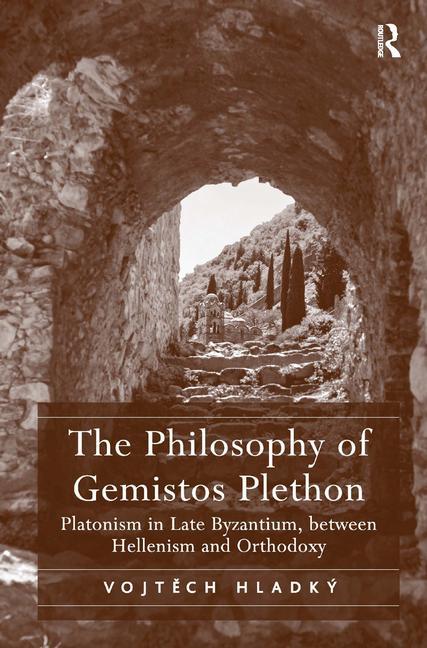
The Philosophy of Gemistos Plethon: Platonism in Late Byzantium, between Hellenism and Orthodoxy - Hardcover
$231.99
$233.99
-1%Quantity
01
Pay over time for orders over $35.00 with
Offers & Perks
Earn 231 points with this purchase
Added to your rewards balance after checkout.
100 points welcome bonus
Create an account and start with extra points.
Availability:In StockTheme:Aspects (Academic)/Philosophical, Chronological Period/Ancient (To 499 A.D.), Chronological Period/Medieval (500-1453) Studies, Religious Orientation/Islamic, Topical/Mentally ChallengedPublish date:1/9/2014Pages:402
Languages:EnglishPublisher:RoutledgeISBN-13:9781409452942ISBN-10:1409452948UPC:9781409452942Book Category:Philosophy, HistoryBook Subcategory:History & Surveys, AncientBook Topic:Ancient & Classical, MedievalSize:9.21 x 6.14 x 0.94 inchesWeight:0.74Product ID:SCAQJF5RVN
George Gemistos Plethon (c. 1360-1454) was a remarkable and influential thinker, active at the time of transition between the Byzantine Middle Ages and the Italian Renaissance. His works cover literary, historical, scientific, but most notably philosophical issues. Plethon is arguably the most important of the Byzantine Platonists and the earliest representative of Platonism in the Renaissance, the movement which generally exercised a huge influence on the development of early modern thought. Thus his treatise on the differences between Plato and Aristotle triggered the Plato-Aristotle controversy of the 15th century, and his ideas impacted on Italian Renaissance thinkers such as Ficino. This book provides a new study of Gemistos' philosophy. The first part is dedicated to the discussion of his 'public philosophy'. As an important public figure, Gemistos wrote several public speeches concerning the political situation in the Peloponnese as well as funeral orations on deceased members of the ruling Palaiologos family. They contain remarkable Platonic ideas, adjusted to the contemporary late Byzantine situation. In the second, most extensive, part of the book the Platonism of Plethon is presented in a systematic way. It is identical with the so-called philosophia perennis, that is, the rational view of the world common to various places and ages. Throughout Plethon's writings, it is remarkably coherent in its framework, possesses quite original features, and displays the influence of ancient Middle and Neo-Platonic discussions. Plethon thus turns out to be not just a commentator on an ancient tradition, but an original Platonic thinker in his own right. In the third part the notorious question of the paganism of Gemistos is reconsidered. He is usually taken for a Platonizing polytheist who gathered around himself a kind of heterodox circle. The whole issue is examined in depth again and all the major evidence discussed, with the result that Gemistos seems rat
Languages:EnglishPublisher:RoutledgeISBN-13:9781409452942ISBN-10:1409452948UPC:9781409452942Book Category:Philosophy, HistoryBook Subcategory:History & Surveys, AncientBook Topic:Ancient & Classical, MedievalSize:9.21 x 6.14 x 0.94 inchesWeight:0.74Product ID:SCAQJF5RVN
VojtÄ>ch HladkÃ1/2 is assistant professor at the Department of Philosophy and History of Sciences, Faculty of Science, Charles University, Prague, Czech Republic.
Publisher: Routledge
Author
Free shipping on orders over $75. Standard shipping takes 3-7 business days. Eligible items may be returned within 30 days of delivery. Conditions apply.