
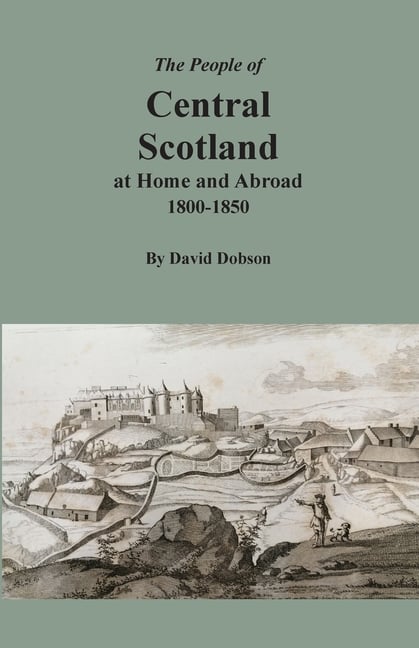
The People of Central Scotland at Home and Abroad, 1800-1850 - Paperback
by David Dobson
$22.99
$25.00
-8%Quantity
01
Pay over time for orders over $35.00 with
Offers & Perks
Earn 22 points with this purchase
Added to your rewards balance after checkout.
100 points welcome bonus
Create an account and start with extra points.
Availability:In StockContributor:David DobsonTheme:Cultural Region/British, Cultural Region/ScottishPublish date:11/7/2022Pages:138
Languages:EnglishPublisher:ClearfieldISBN-13:9780806359526ISBN-10:0806359528UPC:9780806359526Book Category:History, Social Science, ReferenceBook Subcategory:Europe, Immigration & Emigration, Genealogy & HeraldryBook Topic:Great BritainSize:8.50 x 5.50 x 0.30 inchesWeight:0.168Product ID:SC9PTFW4PW
Central Scotland includes the counties of Stirlingshire and neighboring Clackmannanshire, which stretch from Loch Lomond and the Trossachs to the upper reaches of the River Forth. The region is partly in the Highlands and partly in the Lowlands. Most of the early emigration from Central Scotland was by individuals or family groups, but in 1773 the Arnprior Emigration Society formed by farmers in west Stirlingshire organized an emigration to Vermont. In the early 19th century three other emigration societies in Stirlingshire"""Alloa in 1817, Balfron in 1821, and Deanston in 1821"""organized groups of emigrants bound to Upper Canada. The entries in this work, to some extent, enable family historians in the Americas, Australasia, and other locations to link with their kin who remained in Scotland. The Statistical Account of Scotland (OSA), compiled between 1791 and 1799, and the New Statistical Account of Scotland (NSA), compiled between 1832 and 1845, are especially helpful for understanding Scottish society of the period. These can be consulted in major libraries, such as the National Library of Scotland, or online. In the late 18th century, the regional economy was based on farming, textiles, and mining. The existence of iron and coal enabled industrialization to occur relatively early. Coalmining rapidly expanded due to domestic demand and industrial expansion, especially the adoption of the Bolton and Watt steam engines in Scottish textile mills. Supplies of flax were imported from the Baltic, and the linen manufactured became an important export for Central Scotland. The nearly simultaneous Agricultural Revolution caused the merging of small farms, creating a rural labor surplus that either moved to the burgeoning factory towns in the Lowlands or emigrated.
Languages:EnglishPublisher:ClearfieldISBN-13:9780806359526ISBN-10:0806359528UPC:9780806359526Book Category:History, Social Science, ReferenceBook Subcategory:Europe, Immigration & Emigration, Genealogy & HeraldryBook Topic:Great BritainSize:8.50 x 5.50 x 0.30 inchesWeight:0.168Product ID:SC9PTFW4PW
Free shipping on orders over $75. Standard shipping takes 3-7 business days. Eligible items may be returned within 30 days of delivery. Conditions apply.