
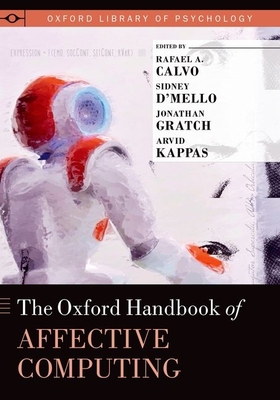
The Oxford Handbook of Affective Computing - Hardcover
$250.99
Quantity
01
Pay over time for orders over $35.00 with
Offers & Perks
Earn 250 points with this purchase
Added to your rewards balance after checkout.
100 points welcome bonus
Create an account and start with extra points.
Availability:In StockContributor:Rafael A. Calvo, Sidney D'Mello, Jonathan GratchSeries:Oxford Library of PsychologyTheme:Aspects (Academic)/Science/Technology AspectsPublish date:12/2/2014Pages:624
Languages:EnglishPublisher:Oxford University PressISBN-13:9780199942237ISBN-10:0199942234UPC:9780199942237Book Category:Psychology, ComputersBook Subcategory:Cognitive Psychology & Cognition, Software Development & EngineeringBook Topic:Systems Analysis & DesignSize:10.00 x 7.20 x 1.40 inchesWeight:1.298Product ID:SCVPXP8QG6
Affective Computing is a growing multidisciplinary field encompassing computer science, engineering, psychology, education, neuroscience, and many other disciplines. It explores how affective factors influence interactions between humans and technology, how affect sensing and affect generation techniques can inform our understanding of human affect, and on the design, implementation, and evaluation of systems that intricately involve affect at their core. The Oxford Handbook of Affective Computing will help both new and experienced researchers identify trends, concepts, methodologies, and applications in this burgeouning field. The volume features 41 chapters divided into five main sections: history and theory, detection, generation, methodologies, and applications. Section One begins with a look at the makings of AC and a historical review of the science of emotion. Chapters discuss the theoretical underpinnings of AC from an interdisciplinary perspective involving the affective, cognitive, social, media, and brain sciences. Section Two focuses on affect detection or affect recognition, which is one of the most commonly investigated areas in AC. Section Three examines aspects of affect generation including the synthesis of emotion and its expression via facial features, speech, postures and gestures. Cultural issues in affect generation are also discussed. Section Four features chapters on methodological issues in AC research, including data collection techniques, multimodal affect databases, emotion representation formats, crowdsourcing techniques, machine learning approaches, affect elicitation techniques, useful AC tools, and ethical issues in AC. Finally, Section Five highlights existing and future applications of AC in domains such as formal and informal learning, games, robotics, virtual reality, autism research, healthcare, cyberpsychology, music, deception, reflective writing, and cyberpsychology. With chapters authored by world leaders in each area, The Oxford Handbook of Affective Computing is suitable for use as a textbook in undergraduate or graduate courses in AC, and will serve as a valuable resource for students, researchers, and practitioners across the globe.
Languages:EnglishPublisher:Oxford University PressISBN-13:9780199942237ISBN-10:0199942234UPC:9780199942237Book Category:Psychology, ComputersBook Subcategory:Cognitive Psychology & Cognition, Software Development & EngineeringBook Topic:Systems Analysis & DesignSize:10.00 x 7.20 x 1.40 inchesWeight:1.298Product ID:SCVPXP8QG6
Rafael A. Calvo, Professor of Software Engineering, University of Sydney Sidney D'Mello, Assistant Professor of Computer Science and Psychology, University of Notre Dame Jonathan Gratch, Research Associate Professor of Computer Science, University of Southern California Arvid Kappas, Professor of Psychology, Jacobs University, Bremen, Germany.
Publisher: Oxford University Press
Contributor(s)
Free shipping on orders over $75. Standard shipping takes 3-7 business days. Returns accepted within 30 days of purchase.