
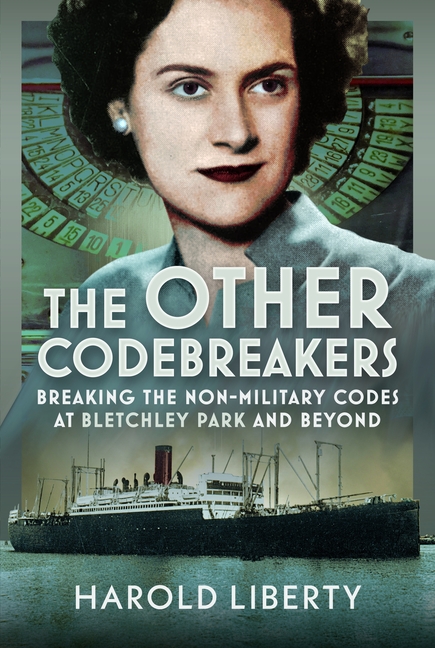
The Other Codebreakers: Breaking the Non-Military Codes at Bletchley Park and Beyond - Hardcover
$32.99
$44.95
-27%Quantity
01
Pay over time for orders over $35.00 with
Offers & Perks
Earn 32 points with this purchase
Added to your rewards balance after checkout.
100 points welcome bonus
Create an account and start with extra points.
Availability:In StockContributor:Harold LibertyTheme:Cultural Region/BritishPublish date:4/30/2026Pages:248
Languages:EnglishPublisher:Pen and Sword HistoryISBN-13:9781036138189ISBN-10:1036138186UPC:9781036138189Book Category:Political Science, HistoryBook Subcategory:Intelligence & Espionage, Military, EuropeBook Topic:Intelligence & Espionage, Great BritainSize:9.30 x 6.23 x 1.19 inchesWeight:0.545Product ID:SCZ5RBF9DV
The non-military codebreakers at Bletchley Park shaped wartime strategy by revealing diplomacy, commerce, and neutral networks' hidden influence.
The work of the Military codebreakers at Bletchley Park is now rightly and justly celebrated for its contribution to the Allied victory in World War Two. The ability to read enemy communications allowed strategic and tactical information to be understood and utilized. However less attention has been given to a range of other non-military codes, and the organisations involved with them, yet their significance on the development of the war is profound. This account outlines how these other areas functioned, who was there and what was achieved. In particular it covers the working of the Diplomatic and Commercial section of the Government Code and Cypher School (GC&CS), which was evacuated to Bletchley Park in August 1939 with the military codebreakers as war loomed, and remained there until early 1942 when the section went back to London to be housed in Berkeley Street and other nearby buildings. The section did not handle military material except where military matters appeared in diplomatic communications (which by their nature were more strategic than combat in nature).
This book sets the scene for the economic, diplomatic, sociological and even psychological struggle which was part of the war, including raw materials, food, power supplies and transportation. Neutral countries, by their very status still able to interact with belligerents on both sides, also played important roles, as did the information that could be drawn from them. The ability to read many neutral messages between representatives gave valuable indications of enemy intentions, issues and conditions.
This new account of the 'other' codebreakers draws on original documents in the National Archives and from Bletchley Park to describe fully how the breaking of non-military codes revealed the activities of diplomats, commercial groups, espionage rings, financial and business interests, traders and smugglers, all locked in a battle of wits. It will be of interest to anyone wanting to learn more about codebreaking, the second world war, and the economics and politics of nations.
The work of the Military codebreakers at Bletchley Park is now rightly and justly celebrated for its contribution to the Allied victory in World War Two. The ability to read enemy communications allowed strategic and tactical information to be understood and utilized. However less attention has been given to a range of other non-military codes, and the organisations involved with them, yet their significance on the development of the war is profound. This account outlines how these other areas functioned, who was there and what was achieved. In particular it covers the working of the Diplomatic and Commercial section of the Government Code and Cypher School (GC&CS), which was evacuated to Bletchley Park in August 1939 with the military codebreakers as war loomed, and remained there until early 1942 when the section went back to London to be housed in Berkeley Street and other nearby buildings. The section did not handle military material except where military matters appeared in diplomatic communications (which by their nature were more strategic than combat in nature).
This book sets the scene for the economic, diplomatic, sociological and even psychological struggle which was part of the war, including raw materials, food, power supplies and transportation. Neutral countries, by their very status still able to interact with belligerents on both sides, also played important roles, as did the information that could be drawn from them. The ability to read many neutral messages between representatives gave valuable indications of enemy intentions, issues and conditions.
This new account of the 'other' codebreakers draws on original documents in the National Archives and from Bletchley Park to describe fully how the breaking of non-military codes revealed the activities of diplomats, commercial groups, espionage rings, financial and business interests, traders and smugglers, all locked in a battle of wits. It will be of interest to anyone wanting to learn more about codebreaking, the second world war, and the economics and politics of nations.
Languages:EnglishPublisher:Pen and Sword HistoryISBN-13:9781036138189ISBN-10:1036138186UPC:9781036138189Book Category:Political Science, HistoryBook Subcategory:Intelligence & Espionage, Military, EuropeBook Topic:Intelligence & Espionage, Great BritainSize:9.30 x 6.23 x 1.19 inchesWeight:0.545Product ID:SCZ5RBF9DV
Free shipping on orders over $75. Standard shipping takes 3-7 business days. Eligible items may be returned within 30 days of delivery. Conditions apply.