
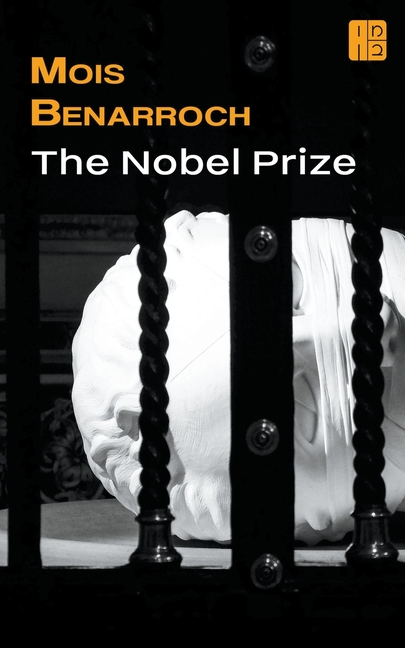
The Nobel Prize - Paperback
Pay over time for orders over $35.00 with
Offers & Perks
Earn 16 points with this purchase
Added to your rewards balance after checkout.
100 points welcome bonus
Create an account and start with extra points.
"If I had a nomination vote for the nobel prize Mois Benarroch would be in the running." Klaus Gerken, Ygdrasil editor.
A group of Hispanic writers live in the foreign city of Irxal. Years later a successful and controversial writer from the group discovers that one of them is in a mental institution, his illness is peculiar and unknown to his psychiatrists: he becomes one of the characters of his books every new day. The writer becomes obsessive about his transformations and goes to visit him almost every day, until the day he is awarded The Nobel Prize. The book is full of frustrated writers, strange characters, nurses and even aliens.
This is what Azorin award winner Spanish writer Javier Perez had to say about the novel: "Writing and madness are never too far away, and some of the greatest writers of all time have been unbearable types settled on a logic at least doubtful. The Nobel Prize, Mois Benarroch forces us to follow through humor, irony and satire and crude acidity through the ravings of a writer who has admitted himself to a mental institution and one of his friends, who he is interested in trying to decipher the keys to his mentality and his work. As neighboring theme, or perhaps central, doubt between popularity and good work, the desire to write for someone without actually bowing to the tastes of the public, a public increasingly less interested in thinking about anything, and jealousy among writers, who systematically lie to one another about publishing, contracts and the number of copies sold of their latest work. Despite its brevity, in the Nobel Prize we can be find nurses having fun with the quirks of their patients, aliens seeking sex with any living creature, wives who doubt whether literature is a profession or a pretext and all kind of characters, some real and some fictional, punctually fulfilling their roles in the farce, disappearing at the right time. In my opinion, although the book wants to look like a humorous entertainment, is a tremendous complaint wrapped in laughter, perhaps because saying it straight could be too crude. It reminded me of lost illusions, of Balzac, with key Sephardic humor." Javier Perez
"The narrator tells us with a bit of humor about the life of a writer. He tells it from the perspective of a writer looking for a story. He explains what it is like not to hear from publishers and the struggles that being a writer can bring. After visiting his friend, the narrator starts to question his sanity at times.
We are also given a look at how a writer can become their characters, in this case literally. We are shown throughout the book how each of a writer's characters are part of the writer himself..... I liked this aspect of the book. I enjoyed the content of the book. I liked how the narrator developed in the book. I think that the topic of a writer becoming his characters was interesting. I think this would be a good book for anyone interested in the psychology of the mind and the life of a writer." online Book Club
"I think the premise was what really drew me in and kept me reading. The narrator is a writer who finds out that an old member of his writing group is in a mental institution. When the narrator visits the hospital, he finds this other writer is acting like his characters, taking on the personality of a different character every day. As the narrator documents his visits to the hospital, his life grows more surreal, as the line between fiction and reality is blurred. The narrative is filled with playful jabs at writers and the craft of writing, and shows how every good writer is just a little insane." TCC Edwards.
Mois Benarroch nació en Tetuán, Marruecos en 1959. A los trece años emigra con sus padres a Israel y desde entonces vive en Jerusalén. Empieza a escribir poesía a los quince años, en Ingles, después en Hebreo, y finalmente en su lengua materna, el castellano. Publica sus primeros poemas en 1979. En los años 80 forma parte de varios grupos de vanguardia y edita la revista Marot. Su primer libro en hebreo aparece en 1994, titulado "Coplas del inmigrante". Publica también dos libros de cuentos, varios libros de poemas en Hebreo, Inglés y Español, y cuatro novelas. En el 2008 es galardonado con el premio del primer ministro en Israel.
En España ha publicado el poemario "Esquina en Tetuán" (Esquío, 2000) y en 2005 la novela "Lucena" (Lf ediciones). En el 2008 la editorial Destino publica la novela "En Las Puertas De Tánger". Y en el 2010 Escalera publica "Amor y Exilios".
Mois Benarroch, novelista, poeta, traductor, ha sido galardonado con el premio del primer ministro (2008) y el premio Yehuda Amichay de poesía (2012)
Contributor(s)
Author
Free shipping on orders over $75. Standard shipping takes 3-7 business days. Returns accepted within 30 days of purchase.