
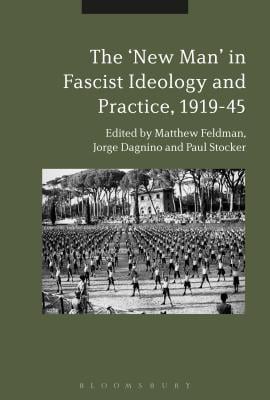
The "New Man" in Radical Right Ideology and Practice, 1919-45 - Hardcover
$192.99
Quantity
01
Pay over time for orders over $35.00 with
Offers & Perks
Earn 192 points with this purchase
Added to your rewards balance after checkout.
100 points welcome bonus
Create an account and start with extra points.
Availability:In StockContributor:Matthew Feldman, Jorge Dagnino, Paul StockerTheme:Chronological Period/20th CenturyPublish date:1/25/2018Pages:320
Languages:EnglishPublisher:Continnuum-3PLISBN-13:9781474281096ISBN-10:1474281095UPC:9781474281096Book Category:History, Political Science, Social ScienceBook Subcategory:Modern, Political Ideologies, AnthropologyBook Topic:20th Century, Fascism & Totalitarianism, Cultural & SocialSize:9.20 x 6.10 x 0.80 inchesWeight:0.59Product ID:SCSH80KAEE
Bringing together an expert group of established and emerging scholars, this book analyses the pervasive myth of the 'new man' in various fascist movements and far-right regimes between 1919 and 1945. Through a series of ground-breaking case studies focusing on countries in Europe, but with additional chapters on Argentina, Brazil and Japan, The "New Man" in Radical Right Ideology and Practice, 1919-45 argues that what many national forms of far-right politics understood at the time as a so-called 'anthropological revolution' is essential to understanding this ideology's bio-political, often revolutionary dynamics. It explores how these movements promoted the creation of a new, ideal human, what this ideal looked like and what this things tell us about fascism's emergence in the 20th century.
The years after World War One saw the rise of regimes and movements professing totalitarian aims. In the case of revolutionary, radical-right movements, these totalising goals extended to changing the very nature of humanity through modern science, propaganda and conquest. At its most extreme, one of the key aims of fascism - the most extreme manifestation of radical right politics between the wars - was to create a 'new man'. Naturally, this manifested itself in different ways in varying national contexts and this volume explores these manifestations in order to better comprehend early 20th-century fascism both within national boundaries and in a broader, transnational context.
The years after World War One saw the rise of regimes and movements professing totalitarian aims. In the case of revolutionary, radical-right movements, these totalising goals extended to changing the very nature of humanity through modern science, propaganda and conquest. At its most extreme, one of the key aims of fascism - the most extreme manifestation of radical right politics between the wars - was to create a 'new man'. Naturally, this manifested itself in different ways in varying national contexts and this volume explores these manifestations in order to better comprehend early 20th-century fascism both within national boundaries and in a broader, transnational context.
Languages:EnglishPublisher:Continnuum-3PLISBN-13:9781474281096ISBN-10:1474281095UPC:9781474281096Book Category:History, Political Science, Social ScienceBook Subcategory:Modern, Political Ideologies, AnthropologyBook Topic:20th Century, Fascism & Totalitarianism, Cultural & SocialSize:9.20 x 6.10 x 0.80 inchesWeight:0.59Product ID:SCSH80KAEE
Jorge Dagnino is Assistant Professor in Modern European History at the Universidad de los Andes, Chile.
Matthew Feldman is Professor in the History of Modern Ideas at Teesside University, UK, and co-director of the Centre for Fascist, Anti-fascist and Post-fascist Studies. Paul Stocker recently submitted his PhD thesis at Teesside University, UK. He is currently Lecturer at Richmond, the American International University in London, UK.Publisher: Continnuum-3PL
Contributor(s)
Free shipping on orders over $75. Standard shipping takes 3-7 business days. Eligible items may be returned within 30 days of delivery. Conditions apply.