
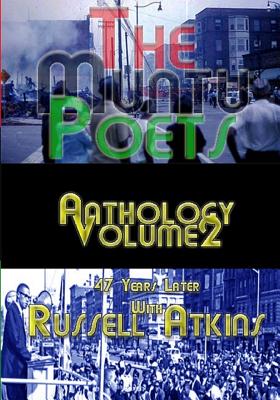
The Muntu Poets - Anthology Volume 2: 47 Years Later with Russell Atkins - Paperback
$12.99
$14.99
-13%Quantity
01
Pay over time for orders over $35.00 with
Offers & Perks
Earn 12 points with this purchase
Added to your rewards balance after checkout.
100 points welcome bonus
Create an account and start with extra points.
Availability:In StockContributor:Norman Jordan, Sababa Akili, Hzal AnubeweiSeries:The Muntu Poets - AnthologyTheme:Ethnic Orientation/African AmericanPublish date:1/1/2016Pages:202
Languages:EnglishPublisher:Uptown Media Joint VenturesISBN-13:9781681210292ISBN-10:1681210290UPC:9781681210292Book Category:PoetryBook Subcategory:African American & BlackSize:10.00 x 7.01 x 0.43 inchesWeight:0.359Product ID:SCMGSTPJG0
The Muntu Poets - a forgotten voice in the mid to late 60's in the city of Cleveland - was an entity that was a product of its time. There were no membership cards or applications to fill out or any barrier to be a Muntu Poet. It was a fluid entity that existed for people in the area waiting to be exposed to poetry and to the technicalities of writing poetry. For the most part, the majority of the poets were young, movement conscious, energetic and upset with the status quo. There wasn't anyone who was laboring under any illusions about our plight. Everyone expressed themselves in different ways I'd say. The poets read all over the place, including in other states, for the better part of 67/68 under the banner of Muntu.The workshop took place once a week at a place on Superior Avenue and Ansel Road on the second floor of the building. There were folks present who were poets before the workshop and people who were there just to check out what was going on. There was an eclectic group of styles present. The voices of dissent were the loudest and it was this group that raised their voices everywhere they went. In their view, there was nothing pretty or funny about the circumstances Black people were in. They were the only group of poets in the city doing that. They felt that everyone else was putting honey and perfume on shit. The poets who had a similar outlook were the ones who usually read together at various venues around the country.The last time that the group officially met was on July 23rd of 1968 at 10518 Elk Avenue. That day, (the beginning of the Glenville Riots) was what the Muntu Poets predicted was coming. Most of the poets continued to write and now they have gathered to write another anthology 47 years after the first was written. This anthology is a tribute to Russell Atkins and Norman Jordan who were the leaders of the powerful group of writers.
Languages:EnglishPublisher:Uptown Media Joint VenturesISBN-13:9781681210292ISBN-10:1681210290UPC:9781681210292Book Category:PoetryBook Subcategory:African American & BlackSize:10.00 x 7.01 x 0.43 inchesWeight:0.359Product ID:SCMGSTPJG0
Russell Atkins is a poet, composer, theorist, editor, and leading literary innovator. He was born on February 25, 1926 in Cleveland, Ohio. From childhood, he exhibited talent in painting, drawing, music, and writing. By age thirteen, he had won several poetry contests. Atkins published his poetry in journals and newspapers, including Experiment (1947-1951) and the New York Times (1951). In 1950, Atkins cofounded what is probably the oldest black-owned literary magazine, Free Lance. He created a style of concrete poetry, utilizing an abstract technique he called "phenomenalism," which juxtaposed unfamiliar and familiar elements. He did not try to make his work comprehensible to casual readers. In 1960 Atkins published his first collection of poetry, A Podium Presentation. Subsequent volumes include Phenomena (1961), Objects (1963), Objects 2 (1964), Heretofore (1968), The Nail, to Be Set to Music (1970), Maleficium (1971), Here in The (1976), and Whichever (1978). Atkins is the lead contributor in two anthologies dedicated to him, Imaginary Crimes In Real Gardens and The Muntu Poets 47 Years Later. Norman Jordan was born in Ansted, West Virginia in 1938. He subsequently earning a bachelor's degree from West Virginia University in theater, and then later a master's degree in African American studies from Ohio State University. Norman Jordan was a poet and a playwright, with his works anthologized in at least 42 books of poetry, making him one of the most published Appalachian poets. His poems have appeared in The Poetry of the Negro, Black Fire, Make a Joyful Sound: Poems for Children by A.A. Poets, In Search of Color Everywhere: A Collection of A.A. Poetry, and Wild Sweet Notes: Fifty years of West Virginia Poetry 1950-1999. A voice and leading force in the Black Arts Movement, Jordan's work also appeared in journals dedicated to the movement such as Journal of Black Poetry and Black World. Jordan had also written five books of poetry: Destination: Ashes (1967), Above Maya (1971), Where Do People In Dreams Come From And Other Poems, Two Books, and Sing Me Different. In 2008, Jordan was inducted into an exclusive group of poets named the Affrilachian Poets. Jordan taught at West Virginia University, among other schools. While living in Ohio, Norman Jordan became a leading force in the Cleveland Poetry Movement, working closely with the Karamu House, the oldest African American theater in the United States.
Publisher: Uptown Media Joint Ventures
Contributor(s)
Authors
Free shipping on orders over $75. Standard shipping takes 3-7 business days. Eligible items may be returned within 30 days of delivery. Conditions apply.