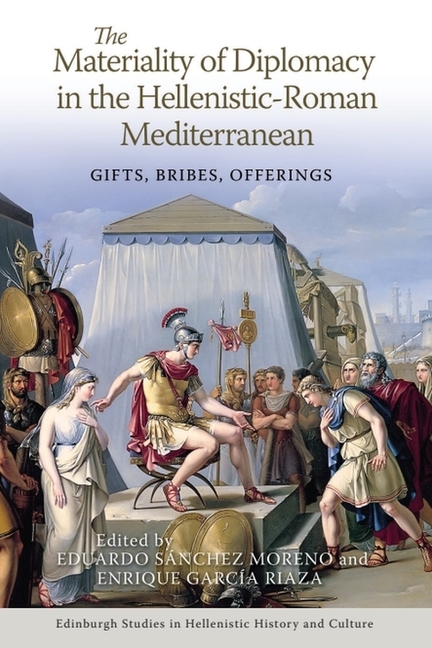

The Materiality of Diplomacy in the Hellenistic-Roman Mediterranean: Gifts, Bribes, Offerings - Hardcover
Pay over time for orders over $35.00 with
This volume is a survey of one of the most interesting practices of ancient diplomacy: the gift or exchange of symbolic objects understood as diplomatic presents. This custom may be as old as mankind, but it can certainly be traced back to the emergence of the first written societies. After assessing this background, the contributions of the volume focus on a transcendental historical epoch: the Hellenistic period (from the end of the 4th century BC to the end of the 1st century BC), which partially overlaps with the expansion of the Roman Republic in the Mediterranean.
The book brings together international specialists who approach the subject from different chronological, geographical and thematic perspectives. A stimulating proposal that opens up new insights into the study of Antiquity and the History of Diplomacy. It provides an innovative approach to the study of ancient diplomacy, based on cultural conditioning factors and subjective perception of the gift and illuminates current issues, such as the role of diplomacy and dialogue between cultures as a means of conflict resolution.
Eduardo S?nchez Moreno is Senior Lecturer in Ancient History at the Department of Ancient History, Medieval History and Diplomatics at the Autonomous University of Madrid (Spain), of which he has been director (2019-2023). He completed a Degree in History with two specialities, Prehistory and Archaeology (1992) and Ancient and Medieval History (1993), and obtained a PhD in Ancient History (1997) at the Autonomous University of Madrid. He made his Postdoc at the University of Oxford (1999-2001) and, in addition, he has been visiting scholar at the universities of Minnesota, Oxford, Waterloo, Edinburgh and Cape Town. His main research interest are the peoples and cultures of Ancient Iberia and the study of Roman imperialism and diplomacy in the Western Mediterranean. Principal Investigator of the Research Group Occidens: Power, Conflict and Diplomacy in the Ancient West (Autonomous University of Madrid). He has taken part in several scientific programs, being a Principal Researcher in different R+D+i projects (Spanish State Research Agency, Government of Spain). He is author of two individual books and nearly eighty academic articles and contributions in collective books; he has edited or co-edited several volumes, such as: Unidos en armas. Coaliciones militares en el Occidente antiguo (Edicions UIB-Ediciones UAM, Palma-Madrid, 2019, with E. Garc?a Riaza), Veinticinco estampas de la Espa?a antigua cincuenta a?os despu?s (1967-2017), En torno a la obra de Antonio Garc?a y Bellido y su actualizaci?n cient?fica (Editorial de la Universidad de Sevilla, 2019), Ideolog?a, identidades e interacci?n en el Mundo Antiguo (Madrid, 2012, with C. del Cerro, G. Mora and J. Pascual), Poder, Cultura e Imagen en el Mundo Antiguo (Ediciones UAM, Madrid, 2011, with G. Mora), and Protohistoria y Antig?edad de la Pen?nsula Ib?rica, volumes I-II (S?lex, Madrid, 2007-2008).
Enrique Garc?a Riaza is Professor in Ancient History at the Department of Historical Sciences and Theory of the Arts, University of the Balearic Islands (Spain). He completed his Degree in History (speciality of Ancient History) at the University of Salamanca (1991), as well as the 'Grado de Salamanca' on Roman History (1992). He defended his doctoral thesis in 1997 (University of the Balearic Islands) later published as a book: Celt?beros y lusitanos frente a Roma: diplomacia y derecho de guerra (Universidad del Pa?s Vasco, Vitoria, 2002). His main research interests are Diplomacy and Law of War during the Roman expansion. Principal Investigator of the Research Group Civitas (University of the Balearic Islands). He has taken part in several scientific programs, being a Principal Researcher in several R + D + i projects (Spanish State Research Agency, Government of Spain). His publications include: "Laureatae litterae. Announcing Victories and Public Opinion in the Middle Republic" in C. Rosillo L?pez (ed.), Communicating Public Opinion in the Roman Republic, Historia - Einzelschriften, Band 256 (Franz Steiner Verlag, Stuttgart, 2019), 85-106, and "Foreign Cities. Institutional Aspects of the Roman Expansion in the Iberian Peninsula (218-133 B. C.)", in M. Jehne - F. Pina Polo (eds.), Foreign Clientelae in the Roman World: a Reconsideration, Historia Einzelschriften, Band 238 (Franz Steiner Verlag, Stuttgart, 2015), 119-140. He has edited or co-edited several volumes, such as: Unidos en armas. Coaliciones militares en el Occidente antiguo (Edicions UIB-Ediciones UAM, Palma-Madrid, 2019, with E. S?nchez Moreno), In fidem venerunt. Expresiones de sometimiento a la Rep?blica Romana en Occidente (Dykinson, Madrid, 2019, with A.-M. Sanz), and De fronteras a provincias. Interacci?n e integraci?n en Occidente (ss. III-I a.C.) (Edicions UIB, Palma, 2011).
Contributor(s)
Eduardo S?nchez Moreno (Editor), Enrique Garc?a Riaza (Editor)
Free shipping on orders over $75. Standard shipping takes 3-7 business days. Returns accepted within 30 days of purchase.
This volume is a survey of one of the most interesting practices of ancient diplomacy: the gift or exchange of symbolic objects understood as diplomatic presents. This custom may be as old as mankind, but it can certainly be traced back to the emergence of the first written societies. After assessing this background, the contributions of the volume focus on a transcendental historical epoch: the Hellenistic period (from the end of the 4th century BC to the end of the 1st century BC), which partially overlaps with the expansion of the Roman Republic in the Mediterranean.
The book brings together international specialists who approach the subject from different chronological, geographical and thematic perspectives. A stimulating proposal that opens up new insights into the study of Antiquity and the History of Diplomacy. It provides an innovative approach to the study of ancient diplomacy, based on cultural conditioning factors and subjective perception of the gift and illuminates current issues, such as the role of diplomacy and dialogue between cultures as a means of conflict resolution.
Eduardo S?nchez Moreno is Senior Lecturer in Ancient History at the Department of Ancient History, Medieval History and Diplomatics at the Autonomous University of Madrid (Spain), of which he has been director (2019-2023). He completed a Degree in History with two specialities, Prehistory and Archaeology (1992) and Ancient and Medieval History (1993), and obtained a PhD in Ancient History (1997) at the Autonomous University of Madrid. He made his Postdoc at the University of Oxford (1999-2001) and, in addition, he has been visiting scholar at the universities of Minnesota, Oxford, Waterloo, Edinburgh and Cape Town. His main research interest are the peoples and cultures of Ancient Iberia and the study of Roman imperialism and diplomacy in the Western Mediterranean. Principal Investigator of the Research Group Occidens: Power, Conflict and Diplomacy in the Ancient West (Autonomous University of Madrid). He has taken part in several scientific programs, being a Principal Researcher in different R+D+i projects (Spanish State Research Agency, Government of Spain). He is author of two individual books and nearly eighty academic articles and contributions in collective books; he has edited or co-edited several volumes, such as: Unidos en armas. Coaliciones militares en el Occidente antiguo (Edicions UIB-Ediciones UAM, Palma-Madrid, 2019, with E. Garc?a Riaza), Veinticinco estampas de la Espa?a antigua cincuenta a?os despu?s (1967-2017), En torno a la obra de Antonio Garc?a y Bellido y su actualizaci?n cient?fica (Editorial de la Universidad de Sevilla, 2019), Ideolog?a, identidades e interacci?n en el Mundo Antiguo (Madrid, 2012, with C. del Cerro, G. Mora and J. Pascual), Poder, Cultura e Imagen en el Mundo Antiguo (Ediciones UAM, Madrid, 2011, with G. Mora), and Protohistoria y Antig?edad de la Pen?nsula Ib?rica, volumes I-II (S?lex, Madrid, 2007-2008).
Enrique Garc?a Riaza is Professor in Ancient History at the Department of Historical Sciences and Theory of the Arts, University of the Balearic Islands (Spain). He completed his Degree in History (speciality of Ancient History) at the University of Salamanca (1991), as well as the 'Grado de Salamanca' on Roman History (1992). He defended his doctoral thesis in 1997 (University of the Balearic Islands) later published as a book: Celt?beros y lusitanos frente a Roma: diplomacia y derecho de guerra (Universidad del Pa?s Vasco, Vitoria, 2002). His main research interests are Diplomacy and Law of War during the Roman expansion. Principal Investigator of the Research Group Civitas (University of the Balearic Islands). He has taken part in several scientific programs, being a Principal Researcher in several R + D + i projects (Spanish State Research Agency, Government of Spain). His publications include: "Laureatae litterae. Announcing Victories and Public Opinion in the Middle Republic" in C. Rosillo L?pez (ed.), Communicating Public Opinion in the Roman Republic, Historia - Einzelschriften, Band 256 (Franz Steiner Verlag, Stuttgart, 2019), 85-106, and "Foreign Cities. Institutional Aspects of the Roman Expansion in the Iberian Peninsula (218-133 B. C.)", in M. Jehne - F. Pina Polo (eds.), Foreign Clientelae in the Roman World: a Reconsideration, Historia Einzelschriften, Band 238 (Franz Steiner Verlag, Stuttgart, 2015), 119-140. He has edited or co-edited several volumes, such as: Unidos en armas. Coaliciones militares en el Occidente antiguo (Edicions UIB-Ediciones UAM, Palma-Madrid, 2019, with E. S?nchez Moreno), In fidem venerunt. Expresiones de sometimiento a la Rep?blica Romana en Occidente (Dykinson, Madrid, 2019, with A.-M. Sanz), and De fronteras a provincias. Interacci?n e integraci?n en Occidente (ss. III-I a.C.) (Edicions UIB, Palma, 2011).
Contributor(s)
Eduardo S?nchez Moreno (Editor), Enrique Garc?a Riaza (Editor)
