
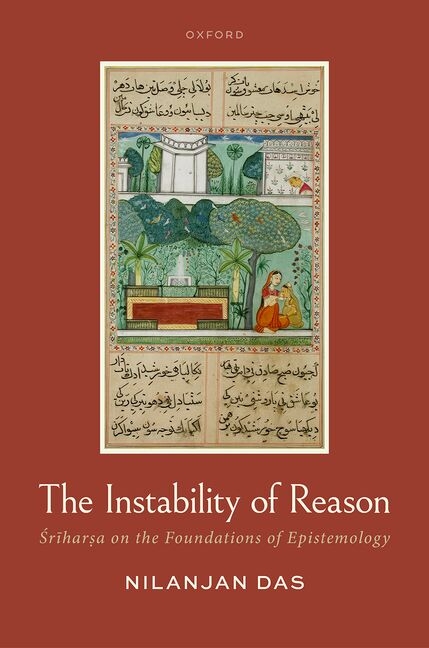
The Instability of Reason: Śrīharṣa on the Foundations of Epistemology - Hardcover
by Nilanjan Das
$161.99
Quantity
01
Pay over time for orders over $35.00 with
Offers & Perks
Earn 161 points with this purchase
Added to your rewards balance after checkout.
100 points welcome bonus
Create an account and start with extra points.
Availability:In StockContributor:Nilanjan DasTheme:Cultural Region/AsianPublish date:7/23/2026Pages:384
Languages:EnglishPublisher:Oxford University PressISBN-13:9780192855190ISBN-10:0192855190UPC:9780192855190Book Category:History, Political ScienceBook Subcategory:Asia, Social History, Colonialism & Post-ColonialismSize:9.48 x 6.34 x 1.16 inchesWeight:0.731Product ID:SC6009W4XD
In premodern south Asia, epistemology (pramāṇaśāstra)--the study of knowledge and the methods of acquiring it--was rarely construed as a purely theoretical enterprise. It was a discipline intended to serve practical purposes. This approach to epistemology is found in the philosophical tradition called Nyāya. The defenders of this tradition, the Naiyāyikas, took Nyāya to be a science of rational inquiry that could assist practitioners of other sciences like economics and government in realizing their distinctive practical aims. These thinkers were committed to Nyāya rationalism: the view that rational inquiry can help us discover all practically important truths about ourselves and the world. Though this view was popular in premodern South Asia, it wasn't without its critics. In this monograph, Nilanjan Das focuses on one such critic of Nyāya rationalism: Śrīharṣa (12th century CE). Śrīharṣa agreed with the Naiyāyikas that liberation (mokṣa or apavarga), i.e., complete freedom from suffering, is the highest aim of human existence, and that we can achieve it by discovering the truth about the self and its relation to the world. But he rejected the claim that rational inquiry can help us discover that truth. This monograph examines how Śrīharṣa defends his anti-rationalist stance against Nyāya epistemologists in his only surviving philosophical work, A Confection of Refutation (Khaṇḍanakhaṇḍakhādya). Śr� 12B;harṣa's criticisms of Nyāya epistemology were significant. On the one hand, they paved the way for theoretical innovations in Nyāya and Vedānta through figures like Citsukha, Gaṅgeśa Upādhyāya, Śaṃkara Miśra and Raghunātha Śiromaṇi. On the other, they reveal the defects of a more general approach to philosophy: an approach that seeks to describe the nature of theoretically interesting categories--like knowledge and causation--by laying down reductive analyses of the corresponding concepts. Śrīharṣa argues that any attempt to offer such conceptual analyses is doomed to fail. Here, this monograph shows, Śrīharṣa anticipates the view of contemporary epistemologists, like Timothy Williamson, who have expressed similar pessimism about the project of analysing knowledge and recommended a form of 'knowledge-first' epistemology.
Languages:EnglishPublisher:Oxford University PressISBN-13:9780192855190ISBN-10:0192855190UPC:9780192855190Book Category:History, Political ScienceBook Subcategory:Asia, Social History, Colonialism & Post-ColonialismSize:9.48 x 6.34 x 1.16 inchesWeight:0.731Product ID:SC6009W4XD
Nilanjan Das, Associate Professor of Philosophy, University of Toronto Nilanjan Das is an Associate Professor in the Department of Philosophy at the University of Toronto. Before coming to Toronto, he taught in Shanghai and London, and did a PhD at MIT. Das works on epistemology and Sanskrit philosophy. In epistemology, he explores connections between self-knowledge and rationality. In Sanskrit philosophy, he examines debates between Buddhist and Brahmanical thinkers about the nature of the self, knowledge, and self-knowledge.
Publisher: Oxford University Press
Contributor(s)
Author
Free shipping on orders over $75. Standard shipping takes 3-7 business days. Eligible items may be returned within 30 days of delivery. Conditions apply.