
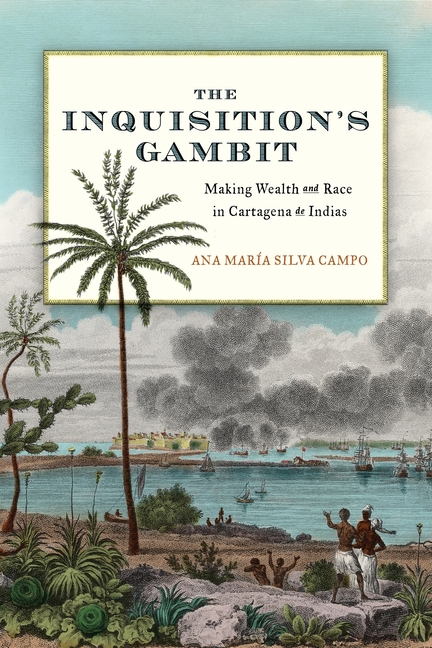
The Inquisition's Gambit: Making Wealth and Race in Cartagena de Indias - Hardcover
$43.99
$45.00
-2%Quantity
01
Pay over time for orders over $35.00 with
Offers & Perks
Earn 43 points with this purchase
Added to your rewards balance after checkout.
100 points welcome bonus
Create an account and start with extra points.
Availability:In StockContributor:Ana Maria Silva CampoSeries:Early Modern AmericasTheme:Chronological Period/17th Century, Cultural Region/Latin America, Religious Orientation/Catholic, Religious Orientation/ChristianPublish date:10/6/2026Pages:264
Languages:EnglishPublisher:University of Pennsylvania PressISBN-13:9781512830026ISBN-10:151283002XUPC:9781512830026Book Category:History, Social ScienceBook Subcategory:Modern, Latin America, EnslavementBook Topic:17th Century, South AmericaSize:9.00 x 6.00 x 0.75 inchesWeight:0.508Product ID:SC1SAY6NYT
A demonstration of how the Spanish Inquisition's property confiscations created a racialized economic order in colonial Cartagena de Indias
In 1632, in the port city of Cartagena de Indias in what is now Colombia, officials of the Spanish Inquisition, having recently arrived to take up their posts, arrested Teodora de Salcedo and fifteen other women of African descent who had once been enslaved, each of whom owned a wood-framed house in one of Cartagena's rapidly changing neighborhoods. The Holy Office declared the women guilty of witchcraft and imposed a range of punishments that included permanent confiscation of all their property. The tribunal then auctioned off their houses to men of Catholic ancestry. During these same years, the Inquisition initially refrained from prosecuting members of the slave-trading elite who were widely suspected of the equally heretical activity of practicing Judaism in secret. It was only later, after they had firmly established themselves in the power structure of the city, that Inquisition officials arrested the Portuguese descendants of Iberian Jews and transferred their property to Old Christian families who were also actively involved in the same trade. Using rarely studied financial records from the Inquisition's archives, The Inquisition's Gambit reveals how this process of selective persecution and wealth redistribution helped create racialized economic hierarchies in a key Spanish colonial city. When the first inquisitors arrived in Cartagena, they found a city where Spanish policies had created an unexpected social order. The Crown had envisioned Christian men controlling wealth and serving as the foundation of Catholic society overseas. Yet imperial policies--the union of the Spanish and Portuguese crowns in 1581 and Spain's designation of Cartagena as the main port for the trade in African captives in 1595--had enabled descendants of Portuguese Jews and women of African descent to prosper. Ana María Silva Campo demonstrates how, through this targeted approach to dispossession and redistribution of property, the Inquisition shaped racialized economic hierarchies and long-term patterns of capital accumulation in the early modern Spanish world.Languages:EnglishPublisher:University of Pennsylvania PressISBN-13:9781512830026ISBN-10:151283002XUPC:9781512830026Book Category:History, Social ScienceBook Subcategory:Modern, Latin America, EnslavementBook Topic:17th Century, South AmericaSize:9.00 x 6.00 x 0.75 inchesWeight:0.508Product ID:SC1SAY6NYT
Ana María Silva Campo is Assistant Professor of History at the University of North Carolina, Chapel Hill. Her work has previously appeared in the Hispanic American Historical Review, the Colonial Latin American Review, and Varia História.
Publisher: University of Pennsylvania Press
Contributor(s)
Author
Free shipping on orders over $75. Standard shipping takes 3-7 business days. Eligible items may be returned within 30 days of delivery. Conditions apply.