
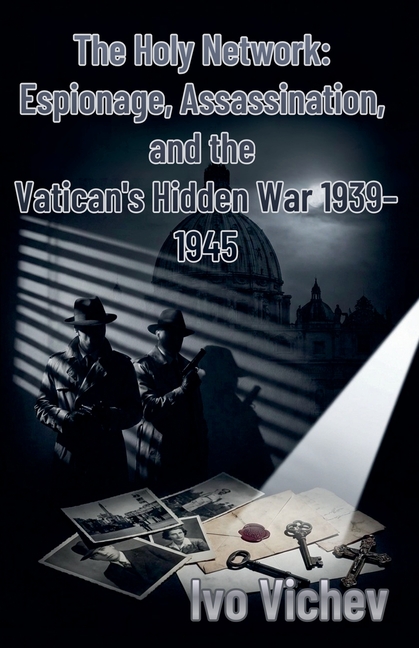
The Holy Network: Espionage, Assassination, and the Vatican's Hidden War 1939-1945 - Paperback
Pay over time for orders over $35.00 with
Offers & Perks
Earn 27 points with this purchase
Added to your rewards balance after checkout.
100 points welcome bonus
Create an account and start with extra points.
The world's smallest sovereign state had no divisions, no tanks, no codebreaking machines, and no independent supply of drinking water. It could be walked across in twenty minutes, and its entire military establishment consisted of a hundred Swiss ceremonial guards whom the Pope had quietly ordered to train on submachine guns. Yet between 1939 and 1945 this 109-acre enclave, surrounded on every side by the capital of a belligerent power, became the most extraordinary intelligence environment in the history of modern warfare - a place where British, American, German, Italian, and Soviet operatives circled one another in the colonnades of St. Peter's Square, where a pope brokered a secret conspiracy to overthrow Adolf Hitler through a Bavarian lawyer and a Jesuit priest, where an Irish monsignor outwitted the Gestapo in a succession of improbable disguises and hid six thousand five hundred people from the machinery of the Final Solution, and where twenty million humanitarian messages created, as an accidental by-product of answering letters from grieving families, the largest intelligence database assembled by any institution during the Second World War.
The Holy Network tells this story from the inside, drawing on the Vatican Apostolic Archives opened in 2020, on declassified Allied and Axis intelligence records, and on the diaries, dispatches, and private papers of the diplomats and priests who lived through it. It follows the clandestine channels from the Lateran Treaty of 1929, which scattered sovereign safe houses across Rome without anyone foreseeing the consequences, through the German occupation and the deportation of Roman Jews within sight of St. Peter's dome, to the post-war ratlines through which the same networks that had rescued the persecuted helped their persecutors escape to South America. It reconstructs the financial architecture of a bank that answered to no earthly authority, the signals intelligence war fought over Vatican Radio's thirty-four language broadcasts, the surveillance and countersurveillance operations conducted by five competing intelligence services within walking distance of the Apostolic Palace, and the slow accumulation of Holocaust intelligence that the Vatican received, recorded, filed - and declined to act on publicly, a silence whose moral weight the opened archives have made not lighter but heavier.
What emerges is neither the saintly refuge of Catholic apologetics nor the monolithic villain of anti-clerical polemic, but something more unsettling than either: a portrait of a deeply human institution that gathered intelligence with breath-taking efficiency, saved thousands of lives through networks of astonishing courage, and then - at the moment when its own evidence demanded a voice equal to the horror it documented - chose the path of institutional preservation over prophetic witness. The gap between what was known and what was said is the central wound of this narrative. The archives have exposed it. They have not healed it. The story that follows is an attempt to understand how both things - the rescue and the silence, the courage and the caution, the four thousand Jews hidden in convents and the thousand loaded onto cattle trucks - could be true at the same time, in the same institution, under the same pope, during the same war.
I was born in Varna, Bulgaria, on the edge of the Black Sea - a place where history is never really "past". Growing up between old empires and new borders, I was surrounded by stories of wars, occupations, disappearances and sudden changes of flag.
Later I moved to Warsaw, Poland, where I studied history and public relations at the Polish Academy of Sciences (PAN). Warsaw is a city built on ruins and memories, and it forced me to ask one question over and over again:
Why is so much of our most important history told in the most boring way possible?
From dry facts to living storiesLike every history student, I spent endless hours buried in heavy academic books - dates, treaties, footnotes stacked on footnotes. I respected the work, but I often felt like the life had been drained out of the events themselves.
That changed when I discovered Ryszard Kapuściński. His books had that rare tone I'd been searching for: history and politics told through people, scenes and atmosphere. It was factual, but it breathed.
From that moment I knew what I wanted to do: take serious history and tell it with the clarity and tension of a documentary - so future generations don't have to suffer through dead, lifeless books to understand the past.
What I write aboutMy books focus on the places where power is most visible - and most hidden:
- Wars and battles
- Espionage and cyber conflict
- Country histories
Some books are big, sweeping national histories. Others zoom in on a single battle, uprising or covert operation. All of them try to answer the same question: What really happened here, and what does it mean for the people who had to live through it?
How I tell historyIf you read my books, you can expect narrative, scene-by-scene storytelling - not just lists of dates. Serious research from archives, memoirs, official reports and investigative journalism. Clear explanations of complex events like cyberattacks and proxy wars. And a refusal to simplify messy, uncomfortable truths.
I don't write official history. I don't write propaganda. I write stories that are honest, human and readable - the kind of books I was always looking for as a student and rarely found.
If you care about how we got from trenches and partitions to cyberwar and drone strikes - and you don't want to fall asleep over another textbook - I wrote these books for you.
"Contributor(s)
Author
Free shipping on orders over $75. Standard shipping takes 3-7 business days. Returns accepted within 30 days of purchase.