
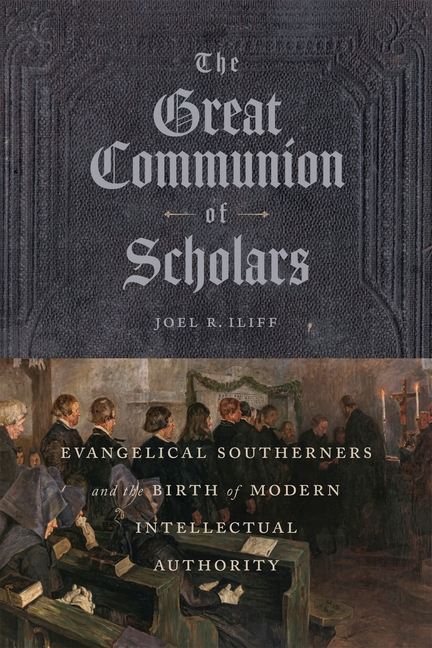
The Great Communion of Scholars: Evangelical Southerners and the Birth of Modern Intellectual Authority - Hardcover
Pay over time for orders over $35.00 with
Offers & Perks
Earn 44 points with this purchase
Added to your rewards balance after checkout.
100 points welcome bonus
Create an account and start with extra points.
While the modern university is typically viewed as secular, Joel R. Iliff argues in The Great Communion of Scholars that the Protestant architects of the modern university in both the U.S. South and Germany consciously patterned their creation on the Christian doctrine of the communion of saints. By attempting to counteract the perceived secularization of their societies, a network of Awakened Protestants on both sides of the Atlantic contributed to the development of modern institutions of higher education and attendant notions of intellectual and moral authority.
Beginning in the 1820s, white southern evangelicals looked abroad and found allies among contemporary religious Awakening movements in Germany. Evangelical southerners and Awakened Germans shared a desire to restore not only intellectual and spiritual order but also social and political order in the wake of the lingering upheavals wrought by the Enlightenment. Eventually, southerners drew analogies between their domestic opponents in the North and the opponents of the Awakened, thus creating the perception of a transatlantic battle between infidelity and orthodoxy, of which the American sectional conflict became one theater. This discourse culminated in the revolutions of 1848 and the American Civil War, which both evangelical southerners and Awakened Germans interpreted as religious struggles with global ramifications. Ultimately, the transnational, ecumenical impulse that fueled the communion of scholars, which reached its zenith in the mid-nineteenth century, proved unstable. It fatefully collapsed over the issue of American slavery when Black evangelical abolitionists in the North waged a successful campaign to brand southern slaveholders, ironically enough, as analogous to the religious radicals and infidels that conservative Protestants on both sides of the Atlantic so feared. By exploring the role that antebellum evangelicalism played in the development of the modern university, Iliff not only dismantles much of what we think we know about the South, American religion, and the origins of the modern higher education but also recovers a lost period in Western intellectual history.Contributor(s)
Author
Free shipping on orders over $75. Standard shipping takes 3-7 business days. Eligible items may be returned within 30 days of delivery. Conditions apply.