
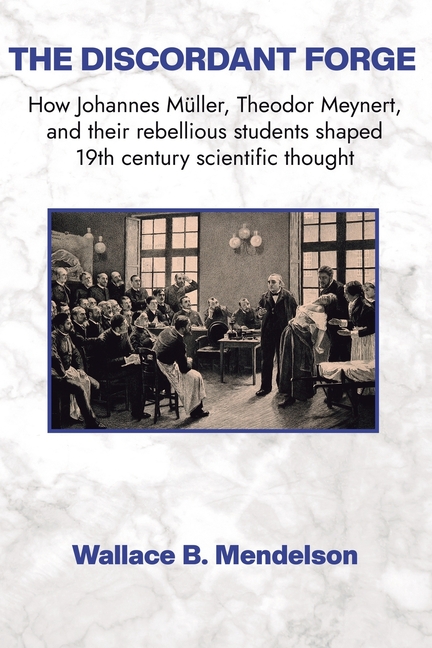
The Discordant Forge: How Johannes Müller, Theodor Meynert, and their rebellious students shaped 19th century scientific thought - Paperback
$10.99
$12.00
-8%Quantity
01
Pay over time for orders over $35.00 with
Offers & Perks
Earn 10 points with this purchase
Added to your rewards balance after checkout.
100 points welcome bonus
Create an account and start with extra points.
Availability:In StockContributor:Wallace B. MendelsonTheme:Chronological Period/19th CenturyPublish date:11/4/2025Pages:96
Languages:EnglishPublisher:Pythagoras PressISBN-13:9798991321020UPC:9798991321020Book Category:HistoryBook Subcategory:ModernBook Topic:19th CenturySize:9.00 x 6.00 x 0.20 inchesWeight:0.141Product ID:SC7AJVGW1Y
Two scientists in 19th century Germany played a crucial role in transforming the study of living organisms from a philosophical pursuit to one based on rigorous scientific observation and experimentation. Johannes Müller made multiple discoveries, such as how nerve fibers transfer signals into and away from the spinal cord, conceptualized the reflex arc, and contributed to findings in embryology and comparative anatomy. He collected all the knowledge of biological systems of his time into a handbook of physiology, and laid the foundations of the modern field of physiology as a distinct scientific discipline. Theodor Meynert, a generation younger, applied these principles of observation and empirical study to mental illness, and argued that symptoms could be associated with specific lesions of the brain. He was among those who established the principle that mental disorders could be studied in terms of brain pathology, and thus helped create the modern field of biological psychiatry. This book describes the lives of these remarkable scientists, and suggests that they had several things in common. First, although they were well known for their original scientific findings, they were equally recognized for the brilliant students they gathered. Second, Müller and Meynert, who had begun their careers with creatively disruptive ideas, were perceived as having later become entrenched in their original findings, with difficulty moving forward. The third similarity in these histories is that the relationships of Müller and Meynert with their students were often complex, in some cases involving resentment and alienation. This was most notable in the stories of Müller and his trainee Emil du Bois-Reymond, as well as of Meynert and the newly minted physician in his clinic, Sigmund Freud. This book examines these three themes, and explores, as well, the vulnerabilities of these mentors; Müller, for instance, made his many discoveries while suffering from depressive episodes, and ultimately died by his own hand. Meynert, on this deathbed, apparently confessed to having suffered from what was then known as male hysteria. The author, a psychiatrist with over 40 years of experience, describes here how these two scientists achieved so much while dealing with both internal vulnerabilities and complex relationships with their students. He concludes that many advances have been made, not simply from the imparting of wisdom by teachers to students of the next generation, but rather from their very human, and often conflictual, interactions.
Languages:EnglishPublisher:Pythagoras PressISBN-13:9798991321020UPC:9798991321020Book Category:HistoryBook Subcategory:ModernBook Topic:19th CenturySize:9.00 x 6.00 x 0.20 inchesWeight:0.141Product ID:SC7AJVGW1Y
Free shipping on orders over $75. Standard shipping takes 3-7 business days. Eligible items may be returned within 30 days of delivery. Conditions apply.