
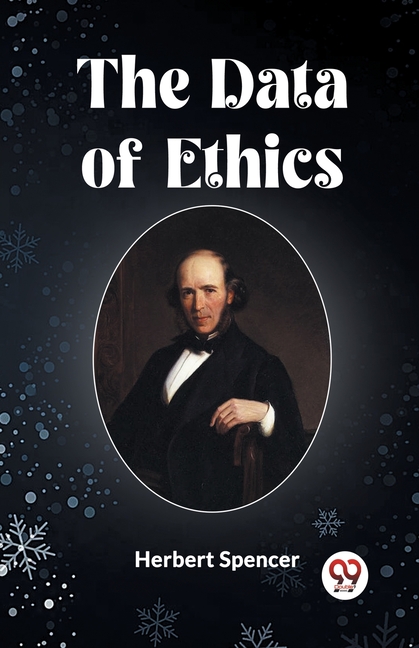
The Data of Ethics - Paperback
$13.99
$18.99
-26%Choose Option
Paperback
$13.99
$18.99

Hardcover
$27.99
$29.99
Quantity
01
Pay over time for orders over $35.00 with
Offers & Perks
Earn 13 points with this purchase
Added to your rewards balance after checkout.
100 points welcome bonus
Create an account and start with extra points.
Availability:In StockContributor:Herbert SpencerTheme:Chronological Period/19th Century, Topical/New AgePublish date:1/1/2024Pages:218
Languages:EnglishPublisher:Double 9 BooksISBN-13:9789360463779ISBN-10:9360463779UPC:9789360463779Book Category:History, PhilosophyBook Subcategory:Ethics & Moral Philosophy, PoliticalSize:8.50 x 5.50 x 0.50 inchesWeight:0.281Product ID:SC1XWSPEZ8
"The Data of Ethics" is a philosophical painting by Herbert Spencer, a distinguished nineteenth-century English logician, sociologist, and evolutionary theorist. Published in 1879, this influential textual content delves into the standards and foundations of ethics from a systematic and evolutionary angle. Herbert Spencer, recognised for his contributions to social theory, applies his evolutionary ideas to the realm of ethics, in search of to set up a systematic foundation for ethical ideas. In "The Data of Ethics," Spencer explores the idea that moral conduct is a fabricated from evolution, arguing that moral principles have evolved over the years as adaptive trends for the survival of societies. The book critically examines numerous ethical theories prevalent in Spencer's time, supplying a complete evaluation of the evolution of ethical sentiments and their connection to social enterprise. Spencer contends that ethical behavior is rooted in the natural development of human societies and draws parallels among biological evolution and the evolution of moral norms. "The Data of Ethics" stays massive inside the history of ethical philosophy for its try to floor moral principles in clinical inquiry. Herbert Spencer's paintings is still studied and debated, contributing to ongoing discussions about the origins and nature of ethical ideals inside the context of societal improvement.
Languages:EnglishPublisher:Double 9 BooksISBN-13:9789360463779ISBN-10:9360463779UPC:9789360463779Book Category:History, PhilosophyBook Subcategory:Ethics & Moral Philosophy, PoliticalSize:8.50 x 5.50 x 0.50 inchesWeight:0.281Product ID:SC1XWSPEZ8
Spencer, Herbert: - English polymath Herbert Spencer worked as a sociologist, anthropological, biologist, psychologist, and philosopher. The phrase "survival of the fittest" was first used by Spencer in Principles of Biology (1864), following his reading of Charles Darwin's 1859 book On the Origin of Species. Although the name primarily denotes natural selection, Spencer also embraced Lamarckism since he believed that evolution extends into the fields of sociology and ethics. Spencer created a comprehensive theory of evolution that included the progressive development of biological systems, the physical environment, human thought, culture, and society. He made contributions to many different fields as a polymath, such as politics, economics, anthropology, ethics, literature, astronomy, biology, sociology, and psychology. He attained great power throughout his lifetime, mostly in academic English-speaking circles. Although Spencer was "the single most famous European intellectual in the closing decades of the nineteenth century," his impact began to wane after 1900. Talcott Parsons questioned, "Who now reads Spencer?" in 1937. Spencer, the son of William George Spencer (often referred to as George), was born in Derby, England, on April 27, 1820.
Publisher: Double 9 Books
Contributor(s)
Author
Free shipping on orders over $75. Standard shipping takes 3-7 business days. Eligible items may be returned within 30 days of delivery. Conditions apply.