
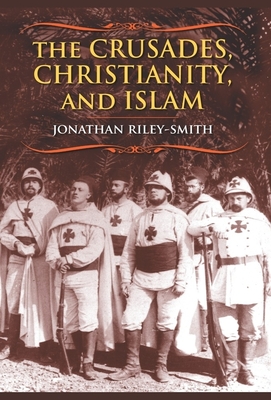
The Crusades, Christianity, and Islam - Hardcover
$110.99
Choose Option
Hardcover
$110.99
$100.00

The Crusades, Christianity, and Islam
$27.99
Quantity
01
Pay over time for orders over $35.00 with
Offers & Perks
Earn 110 points with this purchase
Added to your rewards balance after checkout.
100 points welcome bonus
Create an account and start with extra points.
Availability:In StockContributor:Jonathan Riley-SmithSeries:Bampton Lectures in AmericaTheme:Chronological Period/Medieval (500-1453) Studies, Cultural Region/Middle Eastern, Religious Orientation/Christian, Religious Orientation/IslamicPublish date:9/30/2008Pages:136
The Crusades were penitential war-pilgrimages fought in the Levant and the eastern Mediterranean, as well as in North Africa, Spain, Portugal, Poland, the Baltic region, Hungary, the Balkans, and Western Europe. Beginning in the eleventh century and ending as late as the eighteenth, these holy wars were waged against Muslims and other enemies of the Church, enlisting generations of laymen and laywomen to fight for the sake of Christendom. Crusading features prominently in today's religio-political hostilities, yet the perceptions of these wars held by Arab nationalists, pan-Islamists, and many in the West have been deeply distorted by the language and imagery of nineteenth-century European imperialism. With this book, Jonathan Riley-Smith returns to the actual story of the Crusades, explaining why and where they were fought and how deeply their narratives and symbolism became embedded in popular Catholic thought and devotional life. From this history, Riley-Smith traces the legacy of the Crusades into modern times, specifically within the attitudes of European imperialists and colonialists and within the beliefs of twentieth-century Muslims. Europeans fashioned an interpretation of the Crusades from the writings of Walter Scott and a French contemporary, Joseph-François Michaud. Scott portrayed Islamic societies as forward-thinking, while casting Christian crusaders as culturally backward and often morally corrupt. Michaud, in contrast, glorified crusading, and his followers used its imagery to illuminate imperial adventures. These depictions have had a profound influence on contemporary Western opinion, as well as on Muslim attitudes toward their past and present. Whether regarded as a valid expression of Christianity's divine enterprise or condemned as a weapon of empire, crusading has been a powerful rhetorical tool for centuries. In order to understand the preoccupations of Islamist jihadis and the character of Western discourse on the Middle East, Riley-Smith argues, we must understand how images of crusading were formed in the nineteenth and twentieth centuries.
Jonathan Riley-Smith, Dixie Professor Emeritus of Ecclesiastical History at the University of Cambridge, is the author of nine books, including The Knights of St. John in Jerusalem and Cyprus, c. 1050-1310; The Feudal Nobility and the Kingdom of Jerusalem, 1174-1277; What Were the Crusades? fourth edition; The First Crusade and the Idea of Crusading; The Crusades: A History, second edition; The First Crusaders, 1095-1131; and Templars and Hospitallers as Professed Religious in the Holy Land.
Publisher: Columbia University Press
Contributor(s)
Author
Free shipping on orders over $75. Standard shipping takes 3-7 business days. Eligible items may be returned within 30 days of delivery. Conditions apply.