
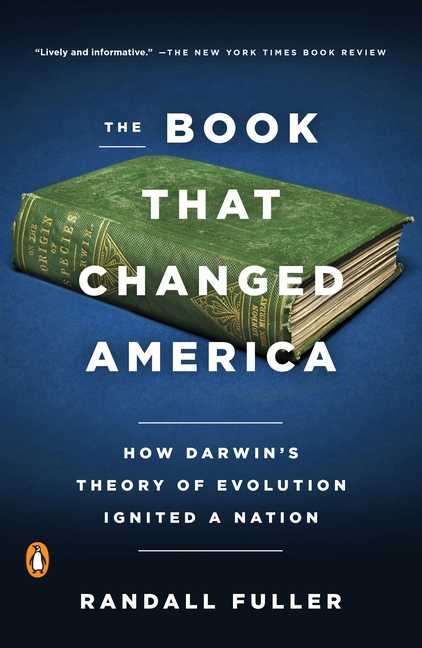
The Book That Changed America: How Darwin's Theory of Evolution Ignited a Nation - Paperback
$15.99
$21.00
-24%Quantity
01
Pay over time for orders over $35.00 with
Offers & Perks
Earn 15 points with this purchase
Added to your rewards balance after checkout.
100 points welcome bonus
Create an account and start with extra points.
Availability:In StockContributor:Randall FullerTheme:Chronological Period/1851-1899, Topical/Civil WarPublish date:1/2/2018Pages:304
Languages:EnglishPublisher:Penguin Publishing GroupISBN-13:9780143130093ISBN-10:0143130099UPC:9780143130093Book Category:History, Philosophy, ScienceBook Subcategory:United States, Movements, Life SciencesBook Topic:Civil War Period (1850-1877), Transcendentalism, EvolutionSize:8.40 x 5.50 x 0.80 inchesWeight:0.272Product ID:SCQWX30QZ8
A compelling portrait of a unique moment in American history when the ideas of Charles Darwin reshaped American notions about nature, religion, science and race "A lively and informative history." - The New York Times Book Review
Throughout its history America has been torn in two by debates over ideals and beliefs. Randall Fuller takes us back to one of those turning points, in 1860, with the story of the influence of Charles Darwin's just-published On the Origin of Species on five American intellectuals, including Bronson Alcott, Henry David Thoreau, the child welfare reformer Charles Loring Brace, and the abolitionist Franklin Sanborn. Each of these figures seized on the book's assertion of a common ancestry for all creatures as a powerful argument against slavery, one that helped provide scientific credibility to the cause of abolition. Darwin's depiction of constant struggle and endless competition described America on the brink of civil war. But some had difficulty aligning the new theory to their religious convictions and their faith in a higher power. Thoreau, perhaps the most profoundly affected all, absorbed Darwin's views into his mysterious final work on species migration and the interconnectedness of all living things. Creating a rich tableau of nineteenth-century American intellectual culture, as well as providing a fascinating biography of perhaps the single most important idea of that time, The Book That Changed America is also an account of issues and concerns still with us today, including racism and the enduring conflict between science and religion.
Throughout its history America has been torn in two by debates over ideals and beliefs. Randall Fuller takes us back to one of those turning points, in 1860, with the story of the influence of Charles Darwin's just-published On the Origin of Species on five American intellectuals, including Bronson Alcott, Henry David Thoreau, the child welfare reformer Charles Loring Brace, and the abolitionist Franklin Sanborn. Each of these figures seized on the book's assertion of a common ancestry for all creatures as a powerful argument against slavery, one that helped provide scientific credibility to the cause of abolition. Darwin's depiction of constant struggle and endless competition described America on the brink of civil war. But some had difficulty aligning the new theory to their religious convictions and their faith in a higher power. Thoreau, perhaps the most profoundly affected all, absorbed Darwin's views into his mysterious final work on species migration and the interconnectedness of all living things. Creating a rich tableau of nineteenth-century American intellectual culture, as well as providing a fascinating biography of perhaps the single most important idea of that time, The Book That Changed America is also an account of issues and concerns still with us today, including racism and the enduring conflict between science and religion.
Languages:EnglishPublisher:Penguin Publishing GroupISBN-13:9780143130093ISBN-10:0143130099UPC:9780143130093Book Category:History, Philosophy, ScienceBook Subcategory:United States, Movements, Life SciencesBook Topic:Civil War Period (1850-1877), Transcendentalism, EvolutionSize:8.40 x 5.50 x 0.80 inchesWeight:0.272Product ID:SCQWX30QZ8
Randall Fuller is the author of From Battlefields Rising: How the Civil War Transformed American Literature, which won the Phi Beta Kappa's Christian Gauss Award for best literary criticism, and Emerson's Ghosts: Literature, Politics, and the Making of Americanists. He has written for The New York Times, The Wall Street Journal, and other publications, and has received fellowships from the Guggenheim Foundation and the National Endowment for the Humanities. He is the Chapman Professor of English at the University of Tulsa.
Publisher: Penguin Publishing Group
Contributor(s)
Author
Free shipping on orders over $75. Standard shipping takes 3-7 business days. Eligible items may be returned within 30 days of delivery. Conditions apply.