
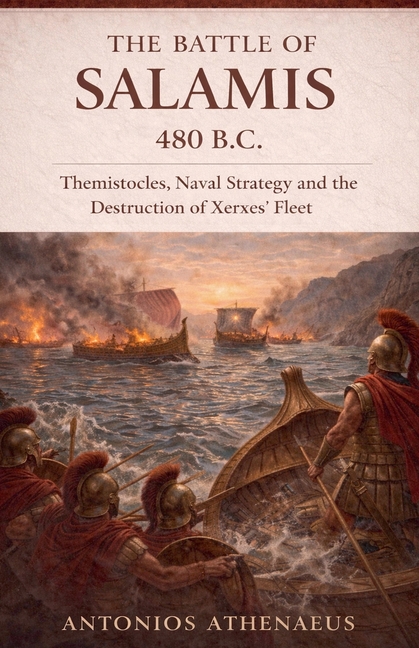
The Battle of Salamis 480 B.C.: Themistocles, Naval Strategy and the Destruction of Xerxes' Fleet - Paperback
Pay over time for orders over $35.00 with
Offers & Perks
Earn 19 points with this purchase
Added to your rewards balance after checkout.
100 points welcome bonus
Create an account and start with extra points.
At Salamis, the fate of Greece was decided in confined waters.
In 480 B.C., Xerxes commanded the largest expeditionary force the ancient world had ever seen. Athens lay in ruins. The Peloponnese prepared for last defense. The Persian Empire appeared unstoppable.
Yet the decisive moment of the campaign would not occur on land.
It would unfold in a narrow strait.
This book presents the Battle of Salamis as a case study in strategic selection of terrain, coalition command under political strain, and the decisive use of naval maneuver to offset numerical inferiority. Rather than recounting a familiar patriotic narrative, it examines how deliberate decision-making transformed a vulnerable alliance into an operationally coherent force.
At the center stands Themistocles - not merely as admiral, but as strategic architect. His insistence on fighting at Salamis, his manipulation of allied hesitation, and his calculated deception of Xerxes are analyzed as coordinated instruments of command. The battlefield was chosen with precision. The enemy was drawn into it by design.
The Persian fleet brought scale, resources, and imperial prestige. What it lacked was unity of control in restricted space. In the confined waters of Salamis, mass became liability. Maneuver dissolved into congestion. Command fragmented.
The Greek fleet, disciplined and tactically aligned, exploited:
- Restricted maneuver corridors
- Concentrated ramming tactics
- Interior lines of movement
- Superior command cohesion
The study reconstructs the battle phase by phase - from Persian encirclement intentions to the collapse of coordination under pressure. It analyzes the interaction between naval doctrine and geography, and the impact of morale, signaling, and tempo on outcome.
Drawing on Herodotus and contemporary sources, the volume includes:
- Political and strategic background of the Hellenic coalition
- Fleet composition and command structure
- Operational reconstruction of the engagement
- Tactical diagrams of trireme deployment
- Strategic consequences for the Persian invasion
Salamis demonstrates a timeless principle: when command unity meets controlled battlespace, numerical superiority loses its advantage.
This book is written for readers of military history, naval warfare, and strategic studies who seek disciplined analysis rather than romantic legend.
Salamis was not the destruction of a fleet.
It was the collapse of imperial momentum.
Antonis Athenaeus is a Greek military officer and author with a lifelong dedication to history and strategy. Drawing on both his professional experience and academic background, he brings ancient battles to life through vivid narrative and modern strategic analysis.
He is the creator of the series Epic Battles of the Ancient World, where each volume explores a decisive clash of antiquity and the timeless lessons of leadership and resilience that still resonate today.
Contributor(s)
Author
Free shipping on orders over $75. Standard shipping takes 3-7 business days. Eligible items may be returned within 30 days of delivery. Conditions apply.