
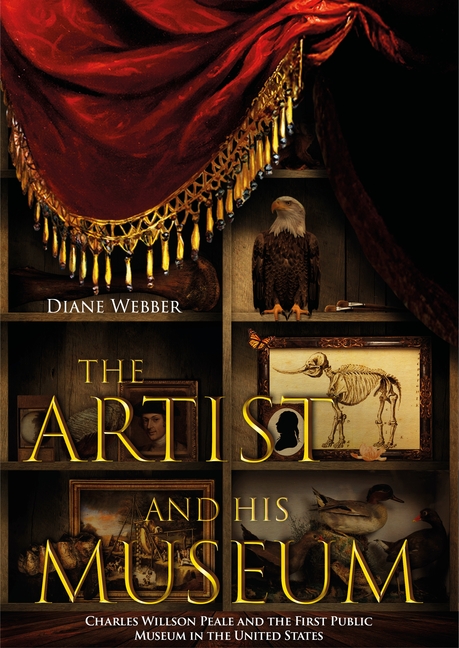
The Artist and His Museum: Charles Willson Peale and the First Public Museum in the United States - Paperback
by Diane Webber
$14.99
$19.95
-25%Quantity
01
Pay over time for orders over $35.00 with
Offers & Perks
Earn 14 points with this purchase
Added to your rewards balance after checkout.
100 points welcome bonus
Create an account and start with extra points.
Availability:In StockContributor:Diane WebberTheme:Cultural Region/Mid-AtlanticPublish date:8/6/2026Pages:128
Languages:EnglishPublisher:Brookline BooksISBN-13:9781955041645ISBN-10:1955041644UPC:9781955041645Book Category:Art, Biography & AutobiographyBook Subcategory:History, Artists, Architects, Photographers, HistoricalSize:9.40 x 6.50 x 0.40 inchesWeight:0.409Product ID:SC8B844Z88
Charles Willson Peale transformed his art gallery into America's first public museum, blending science, education, and public access to create a lasting precedent.
Artist Charles Willson Peale was making detailed drawings of fossilized bones when a relative's off-hand comment sparked an idea in his mind--why not turn his art gallery into a museum of the natural world? People would come. People might even pay! His reputation as a portrait painter was growing, but so was the number of people living under his roof. Charles Willson Peale turned from his career as a successful portrait artist to become the proprietor of America's first public museum. Then (nearly) all of it disappeared, and (nearly) everyone forgot about it. What was Peale's Museum? And where did it go?
Unlike the wealthy person's "cabinet of curiosity" that came before, Charles wanted the museum to be organized by the latest ideas in scientific thinking. He believed useful knowledge should be available to the public, and hoped that his museum might offer Americans a sense of their emerging identity as citizens of a new nation. He dreamed that his museum would become a national, public institution, countering European views of American inferiority. Home to groundbreaking innovations in paleontology, taxidermy, and the role of scientific order, the museum survived yellow fever, multiple moves, and ongoing financial challenges before eventually closing. Today it's largely forgotten. Yet Peale's legacy lives on in the very idea of a museum as a space combining education and entertainment
Artist Charles Willson Peale was making detailed drawings of fossilized bones when a relative's off-hand comment sparked an idea in his mind--why not turn his art gallery into a museum of the natural world? People would come. People might even pay! His reputation as a portrait painter was growing, but so was the number of people living under his roof. Charles Willson Peale turned from his career as a successful portrait artist to become the proprietor of America's first public museum. Then (nearly) all of it disappeared, and (nearly) everyone forgot about it. What was Peale's Museum? And where did it go?
Unlike the wealthy person's "cabinet of curiosity" that came before, Charles wanted the museum to be organized by the latest ideas in scientific thinking. He believed useful knowledge should be available to the public, and hoped that his museum might offer Americans a sense of their emerging identity as citizens of a new nation. He dreamed that his museum would become a national, public institution, countering European views of American inferiority. Home to groundbreaking innovations in paleontology, taxidermy, and the role of scientific order, the museum survived yellow fever, multiple moves, and ongoing financial challenges before eventually closing. Today it's largely forgotten. Yet Peale's legacy lives on in the very idea of a museum as a space combining education and entertainment
Languages:EnglishPublisher:Brookline BooksISBN-13:9781955041645ISBN-10:1955041644UPC:9781955041645Book Category:Art, Biography & AutobiographyBook Subcategory:History, Artists, Architects, Photographers, HistoricalSize:9.40 x 6.50 x 0.40 inchesWeight:0.409Product ID:SC8B844Z88
Webber, Diane: - For decades, Diane Webber has been inviting young people ages five to eighteen to dig deep into history. As an educator, she's devoted to the integration of history into the study of the arts, literature, science, mathematics--nothing truly makes sense without the backstory. A Philadelphia-area resident and museum aficionado, Diane holds an MFA in Writing for Children and Young Adults and in Creative Nonfiction from Spalding University.
Publisher: Brookline Books
Contributor(s)
Author
Free shipping on orders over $75. Standard shipping takes 3-7 business days. Eligible items may be returned within 30 days of delivery. Conditions apply.