
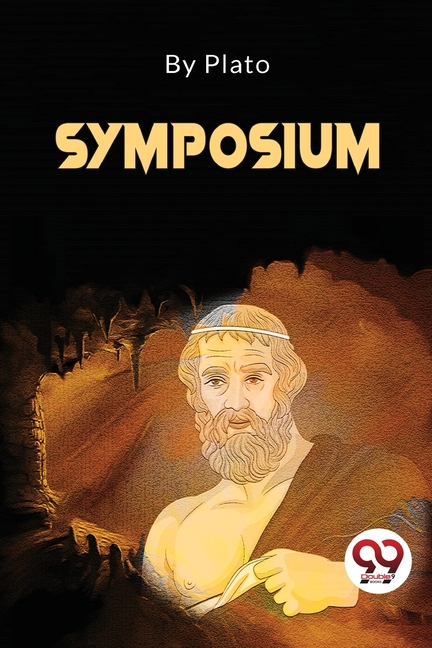
Symposium - Paperback
by Plato
$12.99
$13.99
-7%Choose Option


Quantity
01
Pay over time for orders over $35.00 with
Offers & Perks
Earn 12 points with this purchase
Added to your rewards balance after checkout.
100 points welcome bonus
Create an account and start with extra points.
Availability:In StockContributor:PlatoTheme:Chronological Period/Ancient (To 499 A.D.)Publish date:1/1/2023Pages:74
Languages:EnglishPublisher:Double 9 BooksISBN-13:9789357480222ISBN-10:9357480226UPC:9789357480222Book Category:FictionBook Subcategory:ClassicsSize:9.00 x 6.00 x 0.18 inchesWeight:0.123Product ID:SCS2VBED7Q
A philosophical work by Plato, The Symposium was written between 385 and 370 BC. It depicts a group of distinguished people conversing amicably and making impromptu speeches at a banquet. The playwright Aristophanes, the general and political figure Alcibiades, and the philosopher Socrates serve as representations of the men. The speeches are to honor Eros, the god of passion and love. In the Symposium, Eros is acknowledged as passionate love as well as a phenomenon that can arouse bravery, valor, great acts, and works, as well as dispel man's innate fear of dying. It is viewed as transcending its agrarian roots and reaching the pinnacles of spirituality. The question of whether some of the most extreme meanings might have been meant as humor or farce is raised by this tremendous elevation of the concept of love. Eros is generally always translated as "love," and the English word itself has a number of different meanings and nuances that make it more difficult to comprehend the Eros of classical Athens. One of Plato's most important works, this dialogue is valued for both its philosophical and poetic characteristics.
Languages:EnglishPublisher:Double 9 BooksISBN-13:9789357480222ISBN-10:9357480226UPC:9789357480222Book Category:FictionBook Subcategory:ClassicsSize:9.00 x 6.00 x 0.18 inchesWeight:0.123Product ID:SCS2VBED7Q
Plato: - During the Classical era of ancient Greece, the philosopher Plato was born in Athens. He established the Academy, the first university on the European continent, as well as the Platonist school of philosophy. His interpretation of Plotinus had a significant impact on both Islam and Christianity. His theory of Forms, sometimes known as Platonism, is his most well-known contribution. He is also the inspiration for the Platonic solids and Platonic love. Plato was one of the most important figures in the ancient world, and his body of work is said to have persisted unaltered for more than 2,400 years. Even though little of his predecessors' writings have survived, it is believed that he had a significant impact on the works of Socrates, Heraclitus, Pythagoras, and Parmenides. On a tract of land in the Grove of Hecademus or Academus, a mythical Attic figure, Plato built it. The Academy remained in operation until Lucius Cornelius Sulla demolished it in 84 BC. Seneca claims that Plato passed away on the day of his birth at the age of 81. The Suda reports that he lived to be 82 years old, but Neanthes states that he was 84 years old. Tertullian said that Plato merely passed away while sleeping. By will, Plato bequeathed his Iphistiadae land to a younger relative.
Publisher: Double 9 Books
Free shipping on orders over $75. Standard shipping takes 3-7 business days. Returns accepted within 30 days of purchase.