
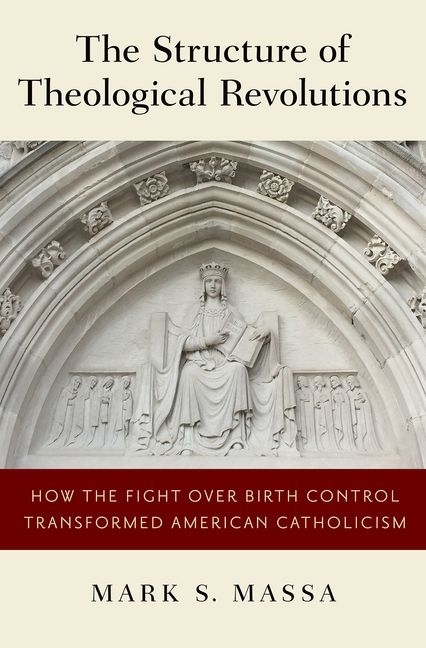
The Structure of Theological Revolutions: How the Fight Over Birth Control Transformed American Catholicism - Hardcover
$48.99
Quantity
01
Pay over time for orders over $35.00 with
Offers & Perks
Earn 48 points with this purchase
Added to your rewards balance after checkout.
100 points welcome bonus
Create an account and start with extra points.
Availability:In StockContributor:Mark S. MassaTheme:Religious Orientation/Catholic, Religious Orientation/ChristianPublish date:8/1/2018Pages:228
On July 29, 1968, Pope Paul VI ended years of discussion and study by Catholic theologians and bishops by issuing an encyclical on human sexuality and birth control entitled Humanae Vitae: "On Human Life." That document, which declared that "each and every marriage act must remain open to the transmission of life," lead to widespread dissent and division within the Church, particularly in the United States. The divide that Humanae Vitae opened up is still with us today.
Mark Massa argues that American Catholics did not simply ignore and dissent from the encyclical's teachings on birth control, but that they also began to question the entire system of natural law theology that had undergirded Catholic thought since the days of Aquinas. Natural law is central to Catholic theology, as some of its most important teachings on issues such as birth control, marriage, and abortion rest on natural law arguments. Drawing inspiration from Thomas Kuhn's classic work The Structure of Scientific Revolutions, Massa argues that Humanae Vitae caused a paradigm shift in American Catholic thought, one that has had far-reaching repercussions.
How can theology-the study of God, whose nature is imagined to be eternal and unchanging- change over time? This is the essential question that The Structure of Theological Revolutions sets out to answer. Massa makes the controversial claim that Roman Catholic teaching on a range of important issues is considerably more provisional and arbitrary than many Catholics think.
Mark Massa argues that American Catholics did not simply ignore and dissent from the encyclical's teachings on birth control, but that they also began to question the entire system of natural law theology that had undergirded Catholic thought since the days of Aquinas. Natural law is central to Catholic theology, as some of its most important teachings on issues such as birth control, marriage, and abortion rest on natural law arguments. Drawing inspiration from Thomas Kuhn's classic work The Structure of Scientific Revolutions, Massa argues that Humanae Vitae caused a paradigm shift in American Catholic thought, one that has had far-reaching repercussions.
How can theology-the study of God, whose nature is imagined to be eternal and unchanging- change over time? This is the essential question that The Structure of Theological Revolutions sets out to answer. Massa makes the controversial claim that Roman Catholic teaching on a range of important issues is considerably more provisional and arbitrary than many Catholics think.
Mark S. Massa, S.J. is Professor of Church History and Director of the Boisi Center for Religion and American Public Life at Boston College. His most recent book is The American Catholic Revolution: How the Sixties Changed the Church Forever (OUP, 2010).
Publisher: Oxford University Press
Contributor(s)
Author
Free shipping on orders over $75. Standard shipping takes 3-7 business days. Eligible items may be returned within 30 days of delivery. Conditions apply.