
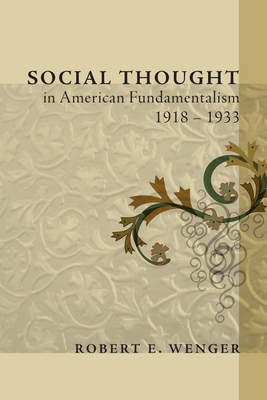
Social Thought in American Fundamentalism, 1918-1933 - Paperback
$31.99
$44.00
-27%Quantity
01
Pay over time for orders over $35.00 with
Offers & Perks
Earn 31 points with this purchase
Added to your rewards balance after checkout.
100 points welcome bonus
Create an account and start with extra points.
Availability:In StockContributor:Robert E. WengerTheme:Religious Orientation/ChristianPublish date:5/1/2007Pages:352
At a time when ""fundamentalist"" evokes an image of a militant social reactionary, it is important to examine the original nature of historical American fundamentalism, from which the term originated. Rejecting as simplistic the stereotypes of fundamentalism in social, political, regional, economic, or psychological categories, this study argues that in the 1920s it was a complex social composite unified by common theological concerns. Among all the social issues confronting Americans in the rapidly changing and uncertain 1920s, fundamentalists reached a consensus only on those that had a direct connection with their biblical faith. The only theme that approximated their theological agreement was their nationalism, and only to the extent that it added urgency to their task of saving America from spiritual ruin. Even in this fundamentalists differed among themselves as to how biblical truth should affect the nation. An examination of fundamentalists' viewpoints toward the intellect, the minorities, and social reform further demonstrates that their common denominator was not a set of cultural characteristics or ideas. It was, rather, a biblically based core of Christian theology. A loose alliance by nature, fundamentalism would have had no cohesiveness at all apart from this core. While fundamentalists by no means escaped cultural influence, the ""fundamentals of the faith"" shaped their view of culture far more than culture shaped their theology. In a generation when the religious faith of many was becoming little more than ""the American way of life,"" they purported to speak to their contemporaries from an external authority--a divinely-inspired Bible.
Robert E. Wenger has since 1983 been Professor of History at Philadelphia Biblical University (formerly Philadelphia College of Bible) in Langhorne, Pennsylvania. From 2001 to 2007 he also served as Dean of the School of Arts and Sciences. His special academic interest lies in American intellectual history. .
Publisher: Wipf & Stock Publishers
Contributor(s)
Author
Free shipping on orders over $75. Standard shipping takes 3-7 business days. Eligible items may be returned within 30 days of delivery. Conditions apply.