
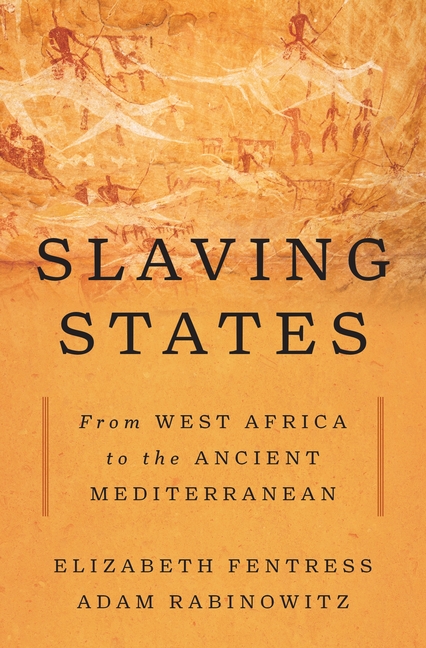
Slaving States: From West Africa to the Ancient Mediterranean - Hardcover
$43.99
Quantity
01
Pay over time for orders over $35.00 with
Offers & Perks
Earn 43 points with this purchase
Added to your rewards balance after checkout.
100 points welcome bonus
Create an account and start with extra points.
Availability:In StockContributor:Elizabeth Fentress, Adam RabinowitzTheme:Chronological Period/Ancient (To 499 A.D.)Publish date:8/25/2026Pages:424
Languages:EnglishPublisher:Princeton University PressISBN-13:9780691288062ISBN-10:0691288062UPC:9780691288062Book Category:Social Science, HistoryBook Subcategory:Enslavement, Archaeology, AncientSize:9.30 x 6.20 x 1.60 inchesWeight:0.863Product ID:SCV7NPGJNV
A pathbreaking new perspective on the ways ancient societies were shaped and transformed by slave trading
The growing economies of ancient Greece and Rome created an ever-increasing demand for enslaved labor, which was supplied by states on the peripheries of their empires. In Slaving States, archaeologists Elizabeth Fentress and Adam Rabinowitz examine how violent bands of warriors in the outlying regions of Gaul, Scythia, and the Fezzan (part of modern-day Libya) gradually became states that specialized in selling humans to the slave economies of Greece and Rome. They trace a series of transformations--of people into objects that could be bought and sold, of warrior bands into state-level societies, and of opportunistic captive-taking into slaving economies. Fentress and Rabinowitz use as a model the West African state of Dahomey, whose development into a slaving state between the seventeenth and nineteenth centuries is, unlike that of their ancient counterparts, well documented. Drawing on textual and archaeological evidence, they show that the slaving zones of early modern West Africa and of antiquity have much in common, rooted in the structure of slaving itself. The evolution of the ancient warriors of Gaul, Scythia, and the Fezzan from head-takers to slave merchants may have taken different paths, but it is clearly written in their histories. With Slaving States, Fentress and Rabinowitz offer an entirely new perspective on ancient slavery. By exploring the supply side of the market for enslaved people, they show that that slavery transforms the society that supplies enslaved people as much as it transforms the society that uses them.Languages:EnglishPublisher:Princeton University PressISBN-13:9780691288062ISBN-10:0691288062UPC:9780691288062Book Category:Social Science, HistoryBook Subcategory:Enslavement, Archaeology, AncientSize:9.30 x 6.20 x 1.60 inchesWeight:0.863Product ID:SCV7NPGJNV
Elizabeth Fentress is an archaeologist and the former Mellon Professor of the Humanities at the American Academy in Rome. In 2022, she received the Gold Medal Award for Distinguished Archaeological Achievement from the American Institute of Archaeology. She is the coauthor of The Berbers: The Peoples of Africa. Adam Rabinowitz is associate professor of classics and acting director of the Institute of Classical Archaeology at the University of Texas at Austin. An active field archaeologist, he currently directs the Histria Multiscalar Archaeological Project at the Greek and Roman city of Histria in Romania.
Publisher: Princeton University Press
Contributor(s)
Authors
Free shipping on orders over $75. Standard shipping takes 3-7 business days. Eligible items may be returned within 30 days of delivery. Conditions apply.