
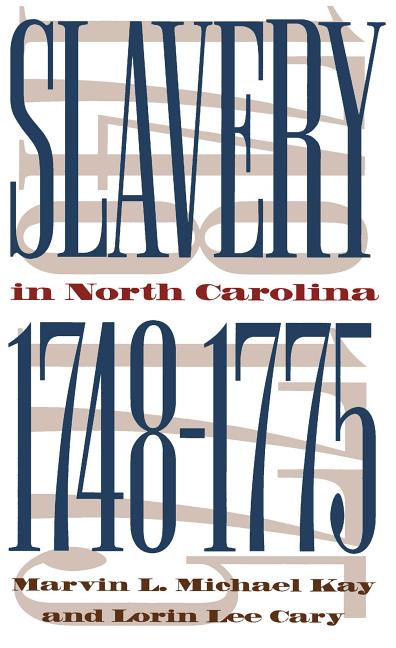
Slavery in North Carolina, 1748-1775 - Paperback
$54.99
$55.00
Quantity
01
Pay over time for orders over $35.00 with
Offers & Perks
Earn 54 points with this purchase
Added to your rewards balance after checkout.
100 points welcome bonus
Create an account and start with extra points.
Availability:In StockContributor:Marvin L. Michael Kay, Lorin Lee CaryTheme:Chronological Period/18th Century, Cultural Region/Deep South, Cultural Region/South, Cultural Region/Southeast U.S., Ethnic Orientation/African American, Geographic Orientation/North CarolinaPublish date:2/22/1999Pages:420
Languages:EnglishPublisher:University of North Carolina PressISBN-13:9780807848197ISBN-10:0807848190UPC:9780807848197Book Category:History, Social ScienceBook Subcategory:United States, EnslavementBook Topic:State & Local, Colonial Period (1600-1775)Size:9.26 x 6.19 x 1.13 inchesWeight:0.654Product ID:SCY2BD571W
Michael Kay and Lorin Cary illuminate new aspects of slavery in colonial America by focusing on North Carolina, which has largely been ignored by scholars in favor of the more mature slave systems in the Chesapeake and South Carolina. Kay and Cary demonstrate that North Carolina's fast-growing slave population, increasingly bound on large plantations, included many slaves born in Africa who continued to stress their African pasts to make sense of their new world. The authors illustrate this process by analyzing slave languages, naming practices, family structures, religion, and patterns of resistance.
Kay and Cary clearly demonstrate that slaveowners erected a Draconian code of criminal justice for slaves. This system played a central role in the masters' attempt to achieve legal, political, and physical hegemony over their slaves, but it impeded a coherent attempt at acculturation. In fact, say Kay and Cary, slaveowners often withheld white culture from slaves rather than work to convert them to it. As a result, slaves retained significant elements of their African heritage and therefore enjoyed a degree of cultural autonomy that freed them from reliance on a worldview and value system determined by whites.
Kay and Cary clearly demonstrate that slaveowners erected a Draconian code of criminal justice for slaves. This system played a central role in the masters' attempt to achieve legal, political, and physical hegemony over their slaves, but it impeded a coherent attempt at acculturation. In fact, say Kay and Cary, slaveowners often withheld white culture from slaves rather than work to convert them to it. As a result, slaves retained significant elements of their African heritage and therefore enjoyed a degree of cultural autonomy that freed them from reliance on a worldview and value system determined by whites.
Languages:EnglishPublisher:University of North Carolina PressISBN-13:9780807848197ISBN-10:0807848190UPC:9780807848197Book Category:History, Social ScienceBook Subcategory:United States, EnslavementBook Topic:State & Local, Colonial Period (1600-1775)Size:9.26 x 6.19 x 1.13 inchesWeight:0.654Product ID:SCY2BD571W
Marvin L. Michael Kay and Lorin Lee Cary are professors emeriti of history at the University of Toledo.
Publisher: University of North Carolina Press
Edition
2nd Edition
Contributor(s)
Authors
Free shipping on orders over $75. Standard shipping takes 3-7 business days. Eligible items may be returned within 30 days of delivery. Conditions apply.