
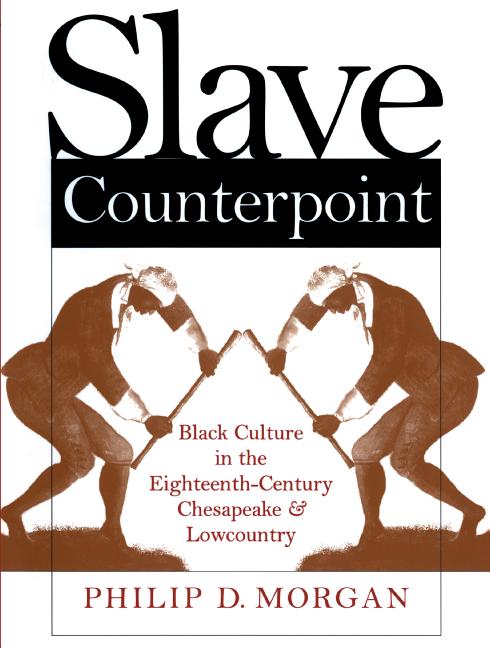
Slave Counterpoint: Black Culture in the Eighteenth-Century Chesapeake and Lowcountry - Paperback
$66.99
$67.00
Quantity
01
Pay over time for orders over $35.00 with
Offers & Perks
Earn 66 points with this purchase
Added to your rewards balance after checkout.
100 points welcome bonus
Create an account and start with extra points.
Availability:In StockContributor:Philip D. MorganSeries:Published by the Omohundro Institute of Early American HistoTheme:Chronological Period/18th Century, Cultural Region/Deep South, Cultural Region/South, Cultural Region/South Atlantic, Cultural Region/Southeast U.S., Ethnic Orientation/African American, Geographic Orientation/South Carolina, Geographic Orientation/VirginiaPublish date:4/27/1998Pages:736
Languages:EnglishPublisher:Omohundro Institute and Unc PressISBN-13:9780807847176ISBN-10:0807847178UPC:9780807847176Book Category:Social Science, HistoryBook Subcategory:Cultural & Ethnic Studies, United States, EnslavementBook Topic:African American & Black Studies, Colonial Period (1600-1775)Size:9.18 x 6.22 x 1.67 inchesWeight:1.053Product ID:SC7Z14CQVK
On the eve of the American Revolution, nearly three-quarters of all African Americans in mainland British America lived in two regions: the Chesapeake, centered in Virginia, and the Lowcountry, with its hub in South Carolina. Here, Philip Morgan compares and contrasts African American life in these two regional black cultures, exploring the differences as well as the similarities. The result is a detailed and comprehensive view of slave life in the colonial American South.
Morgan explores the role of land and labor in shaping culture, the everyday contacts of masters and slaves that defined the possibilities and limitations of cultural exchange, and finally the interior lives of blacks--their social relations, their family and kin ties, and the major symbolic dimensions of life: language, play, and religion. He provides a balanced appreciation for the oppressiveness of bondage and for the ability of slaves to shape their lives, showing that, whatever the constraints, slaves contributed to the making of their history. Victims of a brutal, dehumanizing system, slaves nevertheless strove to create order in their lives, to preserve their humanity, to achieve dignity, and to sustain dreams of a better future.
Morgan explores the role of land and labor in shaping culture, the everyday contacts of masters and slaves that defined the possibilities and limitations of cultural exchange, and finally the interior lives of blacks--their social relations, their family and kin ties, and the major symbolic dimensions of life: language, play, and religion. He provides a balanced appreciation for the oppressiveness of bondage and for the ability of slaves to shape their lives, showing that, whatever the constraints, slaves contributed to the making of their history. Victims of a brutal, dehumanizing system, slaves nevertheless strove to create order in their lives, to preserve their humanity, to achieve dignity, and to sustain dreams of a better future.
Languages:EnglishPublisher:Omohundro Institute and Unc PressISBN-13:9780807847176ISBN-10:0807847178UPC:9780807847176Book Category:Social Science, HistoryBook Subcategory:Cultural & Ethnic Studies, United States, EnslavementBook Topic:African American & Black Studies, Colonial Period (1600-1775)Size:9.18 x 6.22 x 1.67 inchesWeight:1.053Product ID:SC7Z14CQVK
Philip D. Morgan is professor of history at Johns Hopkins University.
Publisher: Omohundro Institute and Unc Press
Contributor(s)
Author
Free shipping on orders over $75. Standard shipping takes 3-7 business days. Returns accepted within 30 days of purchase.