
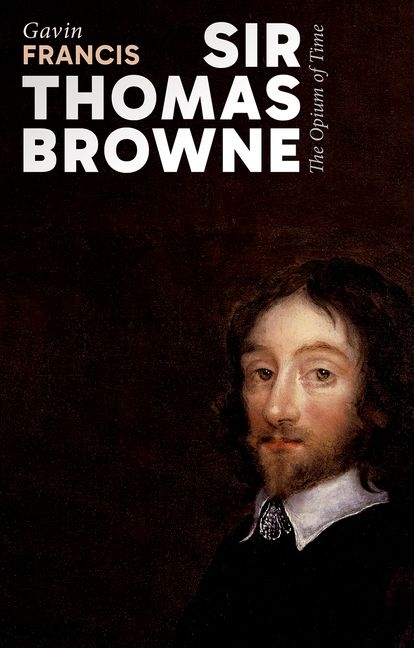
Sir Thomas Browne: The Opium of Time - Paperback
$18.99
Quantity
01
Pay over time for orders over $35.00 with
Offers & Perks
Earn 18 points with this purchase
Added to your rewards balance after checkout.
100 points welcome bonus
Create an account and start with extra points.
Languages:EnglishPublisher:Oxford University PressISBN-13:9780198994909ISBN-10:0198994907UPC:9780198994909Book Category:Literary Criticism, Medical, HistoryBook Subcategory:Renaissance, History, EuropeBook Topic:RenaissanceSize:8.50 x 5.50 x 0.37 inchesWeight:0.209Product ID:SC1F4MQYXT
In this book, Gavin Francis writes about the resonance for him as a medic in reading the work of early modern polymath Sir Thomas Browne. Sir Thomas Browne (1605-1682) was an English physician, wordsmith, and polymath who contributed hundreds of words to the English language (such as medical, electricity, migrant, and computer). After studying medicine in Montpellier, Padua, and Leiden, he settled in Norwich, where he practised as a doctor and wrote some of the greatest books of the seventeenth century, still read for their accessibility and eloquence. In Sir Thomas Browne: The Opium of Time, Dr Gavin Francis examines Browne's work through a variety of themes: ambiguity, curiosity, vitality, piety, humility, misogyny, mobility, and mortality. He argues that the work has lost little of its power and wisdom, and none of its beauty. Religio Medici ('Religion of the Doctor') examined the vexed question of faith in a God who, to a physician, seemed indifferent to suffering. Pseudodoxia Epidemica ('Vulgar Errors') gave free rein to an agile curiosity and sought to debunk notions then commonly believed, such as that dead kingfishers indicate the direction of the wind, or that a woman could get pregnant from sharing a bath with a man. Urne Buriall was Browne's meditation on mortality, occasioned by a find of funerary urns, while Museum Clausum ('Hidden Museum') set out a series of thought experiments and counterfactuals, such as how history might have been different had Alexander the Great marched west instead of east. Gavin Francis draws on his own experiences as a twenty-first century writer and doctor to discover that although many centuries separate him from Browne, they share a fundamental curiosity about the world and about people.
Languages:EnglishPublisher:Oxford University PressISBN-13:9780198994909ISBN-10:0198994907UPC:9780198994909Book Category:Literary Criticism, Medical, HistoryBook Subcategory:Renaissance, History, EuropeBook Topic:RenaissanceSize:8.50 x 5.50 x 0.37 inchesWeight:0.209Product ID:SC1F4MQYXT
Gavin Francis, GP and Fellow of the Royal College of Physicians of Edinburgh and the Royal College of General Practitioners Gavin Francis qualified in medicine from Edinburgh in 1999, then spent ten years travelling, visiting all seven continents. He is the author of seven award-winning books of non-fiction including Adventures in Human Being, Island Dreams, and Recovery: The Lost Art of Convalescence. His work has been translated into eighteen languages. He is a Fellow of the Royal College of Physicians of Edinburgh, and a Fellow of the Royal College of General Practitioners. He lives in Edinburgh, where he also works as a general practitioner.
Publisher: Oxford University Press
Contributor(s)
Author
Free shipping on orders over $75. Standard shipping takes 3-7 business days. Eligible items may be returned within 30 days of delivery. Conditions apply.