
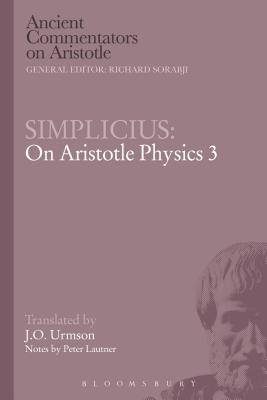
Simplicius: On Aristotle Physics 3 - Paperback
by Simplicius
$58.99
Quantity
01
Pay over time for orders over $35.00 with
Offers & Perks
Earn 58 points with this purchase
Added to your rewards balance after checkout.
100 points welcome bonus
Create an account and start with extra points.
Availability:In StockContributor:Simplicius, Richard Sorabji, J. O. UrmsonSeries:Ancient Commentators on AristotleTheme:Chronological Period/Ancient (To 499 A.D.)Publish date:4/10/2014Pages:240
Languages:EnglishPublisher:Bloomsbury AcademicISBN-13:9781472557353ISBN-10:1472557352UPC:9781472557353Book Category:Psychology, PhilosophyBook Subcategory:Cognitive Psychology & Cognition, History & Surveys, CriticismBook Topic:Ancient & ClassicalSize:9.21 x 6.14 x 0.44 inchesWeight:0.295Product ID:SCXYR510GN
Aristotle's Physics Book 3 covers two subjects: the definition of change and the finitude of the universe. Change enters into the very definition of nature as an internal source of change. Change receives two definitions in chapters 1 and 2, as involving the actualisation of the potential or of the changeable. Alexander of Aphrodisias is reported as thinking that the second version is designed to show that Book 3, like Book 5, means to disqualify change in relations from being genuine change. Aristotle's successor Theophrastus, we are told, and Simplicius himself, prefer to admit relational change. Chapter 3 introduces a general causal principle that the activity of the agent causing change is in the patient undergoing change, and that the causing and undergoing are to be counted as only one activity, however different in definition. Simplicius points out that this paves the way for Aristotle's God who moves the heavens, while admitting no motion in himself. It is also the basis of Aristotle's doctrine, central to Neoplatonism, that intellect is one with the objects it contemplates.In defending Aristotle's claim that the universe is spatially finite, Simplicius has to meet Archytas' question, "What happens at the edge?". He replies that, given Aristotle's definition of place, there is nothing, rather than an empty place, beyond the furthest stars, and one cannot stretch one's hand into nothing, nor be prevented by nothing. But why is Aristotle's beginningless universe not temporally infinite? Simplicius answers that the past years no longer exist, so one never has an infinite collection.
Languages:EnglishPublisher:Bloomsbury AcademicISBN-13:9781472557353ISBN-10:1472557352UPC:9781472557353Book Category:Psychology, PhilosophyBook Subcategory:Cognitive Psychology & Cognition, History & Surveys, CriticismBook Topic:Ancient & ClassicalSize:9.21 x 6.14 x 0.44 inchesWeight:0.295Product ID:SCXYR510GN
J. O. Urmson is Emeritus Professor at Stanford University and Emeritus Fellow of Corpus Christi College, Oxford. Peter Lautner is a fellow of the Research Group for Classical Studies at the Hungarian Academy of Science.
Publisher: Bloomsbury Academic
Contributor(s)
Author
Free shipping on orders over $75. Standard shipping takes 3-7 business days. Returns accepted within 30 days of purchase.