
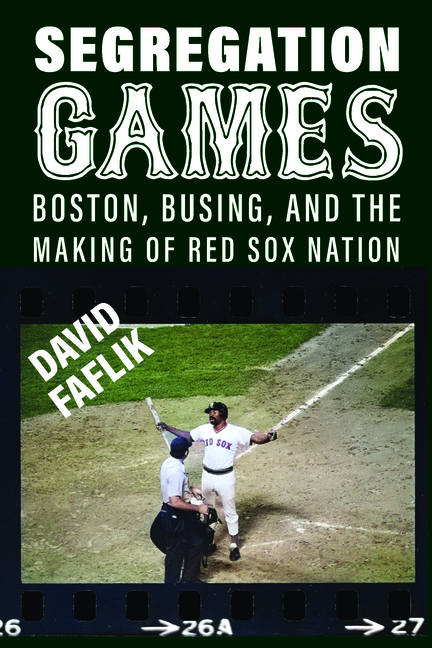
Segregation Games: Boston, Busing, and the Making of Red Sox Nation - Paperback
by David Faflik
$25.99
$29.95
-13%Quantity
01
Pay over time for orders over $35.00 with
Offers & Perks
Earn 25 points with this purchase
Added to your rewards balance after checkout.
100 points welcome bonus
Create an account and start with extra points.
Availability:In StockContributor:David FaflikSeries:Sport for Social ChangeTheme:Cultural Region/New England, Ethnic Orientation/MulticulturalPublish date:5/1/2026Pages:192
Languages:EnglishPublisher:University of Massachusetts PressISBN-13:9781625349286ISBN-10:1625349289UPC:9781625349286Book Category:Sports & Recreation, Social Science, HistoryBook Subcategory:Baseball, Race & Ethnic Relations, United StatesBook Topic:History, State & LocalSize:9.00 x 6.00 x 0.42 inchesWeight:0.25Product ID:SCC1GD7QPY
A cultural history of race, resistance, and representation in a city divided by politics and play
When outfielder Bernie Carbo joined the Red Sox in 1974, he brought with him a toy gorilla named Mighty Joe Young that became the team's unofficial mascot for several players and many in the local press. This seemingly innocent stuffed animal was introduced within a baseball team notorious for its stubborn discrimination, and during a particularly fraught era of racial discord in Boston. That June, after years of activism from the city's Black community, Judge W. Arthur Garrity Jr. ruled that Boston must address the segregation of its schools through redistricting and busing. The ensuing racial animus to these policies led some of the city's white residents to throw bananas and chant monkey sounds at African American students as they integrated the predominantly white South Boston High School. In this agitated atmosphere, cultural symbols like the Red Sox's Mighty Joe Young mirrored and amplified the heightened racial tensions of Boston's busing crisis. Situated at the intersection of US cultural and social history, Segregation Games examines the surprising ties in 1970s Boston between the racial segregation of the city's schools and the racial controversies expressed on and off the field of "Red Sox Nation." "I found out in the black community why they don't come out [to Fenway Park]," explained Black player Reggie Smith of his experiences with the Red Sox and the city during this period. "The team was the last to get Black players, and some of the things I hear out in the stands make me sick." To understand these connections, Faflik erases the lines between politics and sport, which routinely blurred in a city suffused with an anti-Black racism that was both deceptively subtle and fiercely overt. Drawing upon deep archival research from sources that have largely been ignored, such as the Black press of the time, Faflik offers a carefully nuanced portrait of Boston's cultural life at a pivotal moment in the city's history.Languages:EnglishPublisher:University of Massachusetts PressISBN-13:9781625349286ISBN-10:1625349289UPC:9781625349286Book Category:Sports & Recreation, Social Science, HistoryBook Subcategory:Baseball, Race & Ethnic Relations, United StatesBook Topic:History, State & LocalSize:9.00 x 6.00 x 0.42 inchesWeight:0.25Product ID:SCC1GD7QPY
DAVID FAFLIK is professor of English at the University of Rhode Island. His books include That Futebol Feeling: Sport and Play in Brazil's Heartland and Transcendental Heresies: Harvard and the Modern American Practice of Unbelief.
Publisher: University of Massachusetts Press
Contributor(s)
Author
Free shipping on orders over $75. Standard shipping takes 3-7 business days. Eligible items may be returned within 30 days of delivery. Conditions apply.