
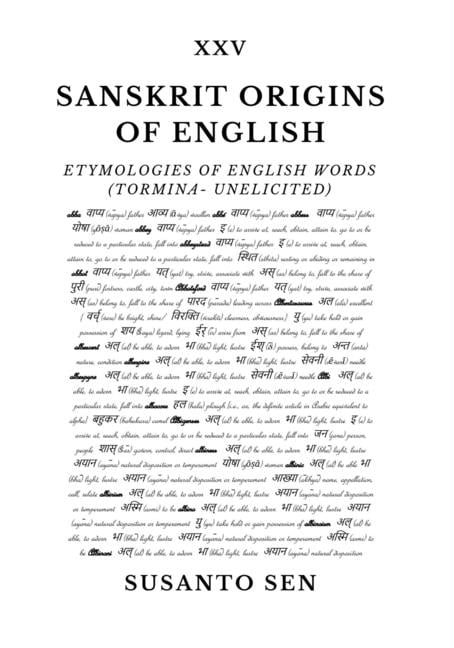
Sanskrit Origins of English: Etymologies of English Words (tormina- unelicited) - Paperback
by Susanto Sen
$22.99
$25.95
-11%Quantity
01
Pay over time for orders over $35.00 with
Offers & Perks
Earn 22 points with this purchase
Added to your rewards balance after checkout.
100 points welcome bonus
Create an account and start with extra points.
Availability:In StockContributor:Susanto SenSeries:Sanskrit Origins of EnglishTheme:Cultural Region/BritishPublish date:7/10/2025Pages:552
Languages:EnglishPublisher:UṢā VijnaISBN-13:9789334306224ISBN-10:933430622XUPC:9789334306224Book Category:History, Language Arts & DisciplinesBook Subcategory:Europe, LinguisticsBook Topic:Great Britain, EtymologySize:10.00 x 7.00 x 1.12 inchesWeight:0.944Product ID:SC4VQS16A9
This book delves into the Sanskrit origins of over 7400 English words, from tormina to unelicited, in alphabetical order. Examples of the Sanskrit origins of English words from this book:
tornado a strong wind which rotates with debris causing a funnel-shaped cloud. The word is cognate with Spanish tornar, meaning "to twist, to turn," Latin tornō, meaning "to turn." (S) द्रुण् (druṇ) bend, make crooked + (S) उत्थ (uttha) coming forth, derived from, originating, arise torpor a state of lethargy, being inactive, or stupor. The word is cognate with Latin torpor, meaning "numbness," and torpeō, meaning "I am numb." (S) ध्रुव (dhruva) immovable, unchangeable + (S) एर् (ēr) raise, procure, obtain, bring near, cause to obtain toward 1. in the direction of, close to, for the purpose of, with respect to. 2. docile, yielding. (S) तय् (tay) go towards or out of + (S) वृत् (vṛt) tend or turn to, follow a course of conduct townhouse 1. a narrow traditional terraced house, which has three or more floors. 2. (archaic) a town hall. 3. a town or city house which is one of the multiple houses belonging to a person. (S) धान (dhāna) site of a habitation + (S) आवास (āvāsa) house tragedy a genre of drama in which one or more of the important characters lead into ruin. The word is cognate with Middle English tragedie, the Old French tragedie, Latin tragoedia, Ancient Greek τραγῳδία (tragōidía), meaning "epic play, tragedy." (S) दुर्जाति (durjāti) misfortune, wicked, ill condition, bad-natured trail to follow behind, to drag behind on the ground, to leave behind. (S) तॄ (tṝ) cross over, get through + (S) हल् (hal) make furrows, plough trashfire fire from trash burning. (S) दॄ (dṝ) torn, scattered, rend or tear asunder, be dispersed or scattered + (S) अस् (as) belong to, fall to the share of + (S) पारु (pāru) fire turmoil trouble, disturbance, a state of extreme uncertainty. (S) दॄ (dṝ) be dispersed or scattered, be frightened or afraid + (S) मिल् (mil) come together, bring together turnbuckle a coupling device which has a turnable central joint by which the device can be shortened or lengthened. (S) द्रुण् (druṇ) bend, make crooked + (S) विषु (viṣu) to press or squeeze out + (S) अल् (al) be able tuskless not having any tusk. (S) द्विशिख (dviśikha) forked, two-pointed + (S) लेश (lēśa) small portion, little bit or slight trace of umbrella 1. a handheld apparel which has an upper frame, especially made of water-resistant material, which is used for protection against rain or sun. 2. anything which provides protection. 3. something which covers a wide range of things. (S) आम्प (āmpa) sunshine + (S) हृ (hṛ) seize, sever, avert, withhold + (S) उल्लू (ullū) cutting off undersense a subconscious or inner awareness. (S) अन्त्य (antya) undermost + (S) सञ्चय (sañcaya) gathering, collection underplant to have smaller plants growing around a larger plant. (S) अन्त्य (antya) undermost + (S) फलान्त
tornado a strong wind which rotates with debris causing a funnel-shaped cloud. The word is cognate with Spanish tornar, meaning "to twist, to turn," Latin tornō, meaning "to turn." (S) द्रुण् (druṇ) bend, make crooked + (S) उत्थ (uttha) coming forth, derived from, originating, arise torpor a state of lethargy, being inactive, or stupor. The word is cognate with Latin torpor, meaning "numbness," and torpeō, meaning "I am numb." (S) ध्रुव (dhruva) immovable, unchangeable + (S) एर् (ēr) raise, procure, obtain, bring near, cause to obtain toward 1. in the direction of, close to, for the purpose of, with respect to. 2. docile, yielding. (S) तय् (tay) go towards or out of + (S) वृत् (vṛt) tend or turn to, follow a course of conduct townhouse 1. a narrow traditional terraced house, which has three or more floors. 2. (archaic) a town hall. 3. a town or city house which is one of the multiple houses belonging to a person. (S) धान (dhāna) site of a habitation + (S) आवास (āvāsa) house tragedy a genre of drama in which one or more of the important characters lead into ruin. The word is cognate with Middle English tragedie, the Old French tragedie, Latin tragoedia, Ancient Greek τραγῳδία (tragōidía), meaning "epic play, tragedy." (S) दुर्जाति (durjāti) misfortune, wicked, ill condition, bad-natured trail to follow behind, to drag behind on the ground, to leave behind. (S) तॄ (tṝ) cross over, get through + (S) हल् (hal) make furrows, plough trashfire fire from trash burning. (S) दॄ (dṝ) torn, scattered, rend or tear asunder, be dispersed or scattered + (S) अस् (as) belong to, fall to the share of + (S) पारु (pāru) fire turmoil trouble, disturbance, a state of extreme uncertainty. (S) दॄ (dṝ) be dispersed or scattered, be frightened or afraid + (S) मिल् (mil) come together, bring together turnbuckle a coupling device which has a turnable central joint by which the device can be shortened or lengthened. (S) द्रुण् (druṇ) bend, make crooked + (S) विषु (viṣu) to press or squeeze out + (S) अल् (al) be able tuskless not having any tusk. (S) द्विशिख (dviśikha) forked, two-pointed + (S) लेश (lēśa) small portion, little bit or slight trace of umbrella 1. a handheld apparel which has an upper frame, especially made of water-resistant material, which is used for protection against rain or sun. 2. anything which provides protection. 3. something which covers a wide range of things. (S) आम्प (āmpa) sunshine + (S) हृ (hṛ) seize, sever, avert, withhold + (S) उल्लू (ullū) cutting off undersense a subconscious or inner awareness. (S) अन्त्य (antya) undermost + (S) सञ्चय (sañcaya) gathering, collection underplant to have smaller plants growing around a larger plant. (S) अन्त्य (antya) undermost + (S) फलान्त
Languages:EnglishPublisher:UṢā VijnaISBN-13:9789334306224ISBN-10:933430622XUPC:9789334306224Book Category:History, Language Arts & DisciplinesBook Subcategory:Europe, LinguisticsBook Topic:Great Britain, EtymologySize:10.00 x 7.00 x 1.12 inchesWeight:0.944Product ID:SC4VQS16A9
Free shipping on orders over $75. Standard shipping takes 3-7 business days. Returns accepted within 30 days of purchase.