
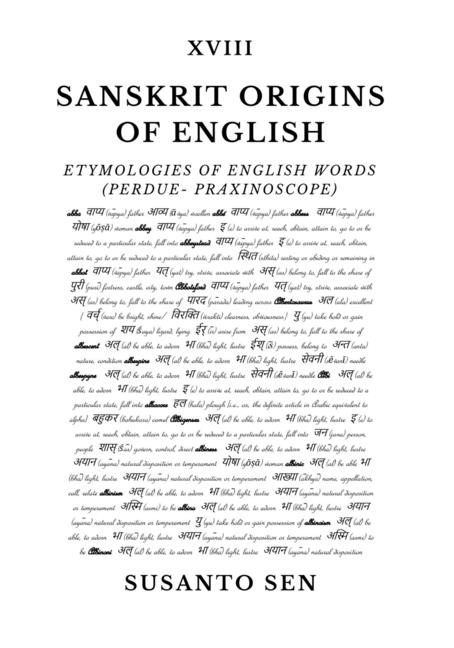
Sanskrit Origins of English: Etymologies of English Words (perdue- praxinoscope) - Paperback
by Susanto Sen
$22.99
$25.95
-11%Quantity
01
Pay over time for orders over $35.00 with
Offers & Perks
Earn 22 points with this purchase
Added to your rewards balance after checkout.
100 points welcome bonus
Create an account and start with extra points.
Availability:In StockContributor:Susanto SenSeries:Sanskrit Origins of EnglishTheme:Cultural Region/BritishPublish date:7/10/2025Pages:552
Languages:EnglishPublisher:UṢā VijnaISBN-13:9789334305395ISBN-10:9334305398UPC:9789334305395Book Category:History, Language Arts & DisciplinesBook Subcategory:Europe, LinguisticsBook Topic:Great Britain, EtymologySize:10.00 x 7.00 x 1.12 inchesWeight:0.944Product ID:SC3VX837MB
This book traces the Sanskrit origins of over 7400 English words, from perdue to praxinoscope, in alphabetical order. Examples of the Sanskrit origins of English words from this book:
peregrine wandering, travelling, migratory, foreign, alien. The word is cognate with Latin peregrīnus, meaning "foreign." (S) पर (para) other, another + (S) गृह (gṛha) home, house + (S) अयन (ayana) manner, course perforate to make a hole or holes by piercing. (S) पर (para) exceeding, beyond + (S) विहृ (vihṛ) sever, lacerate + (S) यत् (yat) try, strive, associate with periotic surrounding the ear. (S) परि (pari) around + (S) ऊहते (ūhatē) listen for + (S) आख्या (ākhyā) name, appellation, call, relate physics a scientific study of matter, its constituents and interrelationships in the observable universe. (S) पाश (pāśa) nature + (S) आख्या (ākhyā) name, appellation, call, relate + (S) अस् (as) belong to, fall to the share of piffle nonsense, foolish talk. (S) विफल (viphala) fruitless, futile, ineffectual, idle, vain pilcrow the symbol . The name is probably via Middle English pylcrafte. (S) वालाग्र (vālāgra) having a hair-like point pile to place things one over the other. (S) पुल् (pul) be piled or heaped up pineapple 1. a large fruit which has prickly skin and stiff prickly leaves on top. 2. the plant that bears pineapples. (S) भिन्न (bhinna) pierced, cleaving to, stab + (S) आताफल (ātāphala) apple pisky 1. a playful sprite, elflike or fairy-like creature. 2. a butterfly of Melanis genus. (S) पक्षि (pakṣi) bird Pluto 1. the god of the underworld in Greek and Roman mythology. The name is cognate with Ancient Greek Πλούτων (Ploútōn), meaning "god of the underworld." 2. the ninth planet in the solar system which was reclassified as a dwarf planet in 2006. The name was coined by Venetia Burney based on the name of the Greek and Roman god Pluto. (S) प्लुत (pluta) submerged + (S) यु (yu) take hold or gain possession of polydactyl having more digits, fingers or toes than what is considered normal. (S) पुली (pulī) bunch + (S) दशत् (daśat) consisting of ten + (S) अल् (al) be able poussin 1. a chicken reared for a few weeks to be eaten as food. 2. a Cornish game hen. ■ The word is cognate with French poussin. (S) पोषण (pōṣaṇa) nourishing, maintaining, keeping poverty the state of being poor. (S) पाप (pāpa) wretched, misfortune, sin, evil + (S) आर्ति (ārti) painful occurrence
peregrine wandering, travelling, migratory, foreign, alien. The word is cognate with Latin peregrīnus, meaning "foreign." (S) पर (para) other, another + (S) गृह (gṛha) home, house + (S) अयन (ayana) manner, course perforate to make a hole or holes by piercing. (S) पर (para) exceeding, beyond + (S) विहृ (vihṛ) sever, lacerate + (S) यत् (yat) try, strive, associate with periotic surrounding the ear. (S) परि (pari) around + (S) ऊहते (ūhatē) listen for + (S) आख्या (ākhyā) name, appellation, call, relate physics a scientific study of matter, its constituents and interrelationships in the observable universe. (S) पाश (pāśa) nature + (S) आख्या (ākhyā) name, appellation, call, relate + (S) अस् (as) belong to, fall to the share of piffle nonsense, foolish talk. (S) विफल (viphala) fruitless, futile, ineffectual, idle, vain pilcrow the symbol . The name is probably via Middle English pylcrafte. (S) वालाग्र (vālāgra) having a hair-like point pile to place things one over the other. (S) पुल् (pul) be piled or heaped up pineapple 1. a large fruit which has prickly skin and stiff prickly leaves on top. 2. the plant that bears pineapples. (S) भिन्न (bhinna) pierced, cleaving to, stab + (S) आताफल (ātāphala) apple pisky 1. a playful sprite, elflike or fairy-like creature. 2. a butterfly of Melanis genus. (S) पक्षि (pakṣi) bird Pluto 1. the god of the underworld in Greek and Roman mythology. The name is cognate with Ancient Greek Πλούτων (Ploútōn), meaning "god of the underworld." 2. the ninth planet in the solar system which was reclassified as a dwarf planet in 2006. The name was coined by Venetia Burney based on the name of the Greek and Roman god Pluto. (S) प्लुत (pluta) submerged + (S) यु (yu) take hold or gain possession of polydactyl having more digits, fingers or toes than what is considered normal. (S) पुली (pulī) bunch + (S) दशत् (daśat) consisting of ten + (S) अल् (al) be able poussin 1. a chicken reared for a few weeks to be eaten as food. 2. a Cornish game hen. ■ The word is cognate with French poussin. (S) पोषण (pōṣaṇa) nourishing, maintaining, keeping poverty the state of being poor. (S) पाप (pāpa) wretched, misfortune, sin, evil + (S) आर्ति (ārti) painful occurrence
Languages:EnglishPublisher:UṢā VijnaISBN-13:9789334305395ISBN-10:9334305398UPC:9789334305395Book Category:History, Language Arts & DisciplinesBook Subcategory:Europe, LinguisticsBook Topic:Great Britain, EtymologySize:10.00 x 7.00 x 1.12 inchesWeight:0.944Product ID:SC3VX837MB
Free shipping on orders over $75. Standard shipping takes 3-7 business days. Returns accepted within 30 days of purchase.