
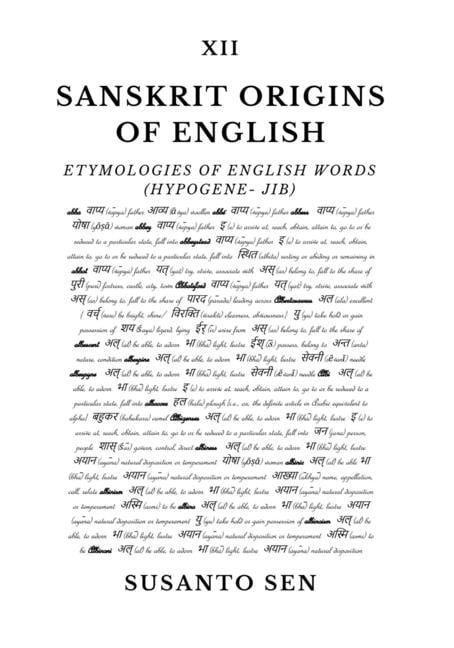
Sanskrit Origins of English: Etymologies of English Words (hypogene- jib) - Paperback
by Susanto Sen
$22.99
$25.95
-11%Quantity
01
Pay over time for orders over $35.00 with
Offers & Perks
Earn 22 points with this purchase
Added to your rewards balance after checkout.
100 points welcome bonus
Create an account and start with extra points.
Availability:In StockContributor:Susanto SenSeries:Sanskrit Origins of EnglishTheme:Cultural Region/BritishPublish date:7/10/2025Pages:552
Languages:EnglishPublisher:UṢā VijnaISBN-13:9789334303568ISBN-10:9334303565UPC:9789334303568Book Category:History, Language Arts & DisciplinesBook Subcategory:Europe, LinguisticsBook Topic:Great Britain, EtymologySize:10.00 x 7.00 x 1.12 inchesWeight:0.944Product ID:SC791TREW0
This book delves into the Sanskrit origins of over 7400 English words, from hypogene to jib, in alphabetical order. Examples of the Sanskrit origins of English words from this book:
hypogene producing or being under the earth's surface. (S) उपोह् (upōh) push under + (S) ज्या (jyā) earth + (S) इन (ina) able hypoglossal occurring under the tongue. (S) उपोह् (upōh) push under + (S) गल (gala) throat + (S) अस् (as) belong to, fall to the share of + (S) अल् (al) be able Icarus son of Daedalus in Greek mythology who flew close to the sun with wings of wax which melted and caused him to fall and drown in the Aegean Sea. The name is cognate with Latin Īcarus, Ancient Greek Ἴκαρος (Íkaros). (S) इ (e) to arrive at, reach, obtain, attain to, go to or be reduced to a particular state, fall into + (S) क्षर् (kṣar) melt away, fall or slip from + (S) अस् (as) belong to, fall to the share of iceberg a large block of ice floating on water after having detached itself from a glacier or a body of ice. (S) इ (e) to arrive at, reach, obtain, attain to, go to or be reduced to a particular state, fall into + (S) श्यै (śyai) freeze, be cold + (S) वर्ग (varga) section, separate division idiot a fool. The word is cognate with Middle English idiote, ydiote, Old French idiote, Latin idiota, Ancient Greek ἰδιώτης (idiṓtēs). (S) अद्युत् (adyut) destitute of brightness idledom (Scotland) idleness. (S) अटल (aṭala) not shaky, firm, steady, fixed + (S) दम (dama) self-command, taming, subduing, house, home inalienable not possible of being alienated. (S) हीन (hīna) free from, incomplete, excluded or shut out from + (S) अ (a) without, not + (S) लि (li) sameness, equality + (S) अन (ana) this + (S) आ (ā) up to, to be + (S) बल (bala) ability, strength jabberwock speech consisting of nonsensical or meaningless words. + (S) एर् (ēr) raise, procure, obtain, bring near, cause to obtain + (S) वाक (vāka) speaking, chattering jackal 1. a type of wild dog that has a bushy tail and long legs. 2. someone who collaborates to perform menial or base acts, like a pack of jackals. (S) शृगाल (śṛgāla) jackal jacket 1. an outer garment worn over a shirt. 2. an outer protective covering or wrapper of something. 3. potato skin. (S) चक् (cak) resist, repel + (S) यत् (yat) try, strive, associate with
hypogene producing or being under the earth's surface. (S) उपोह् (upōh) push under + (S) ज्या (jyā) earth + (S) इन (ina) able hypoglossal occurring under the tongue. (S) उपोह् (upōh) push under + (S) गल (gala) throat + (S) अस् (as) belong to, fall to the share of + (S) अल् (al) be able Icarus son of Daedalus in Greek mythology who flew close to the sun with wings of wax which melted and caused him to fall and drown in the Aegean Sea. The name is cognate with Latin Īcarus, Ancient Greek Ἴκαρος (Íkaros). (S) इ (e) to arrive at, reach, obtain, attain to, go to or be reduced to a particular state, fall into + (S) क्षर् (kṣar) melt away, fall or slip from + (S) अस् (as) belong to, fall to the share of iceberg a large block of ice floating on water after having detached itself from a glacier or a body of ice. (S) इ (e) to arrive at, reach, obtain, attain to, go to or be reduced to a particular state, fall into + (S) श्यै (śyai) freeze, be cold + (S) वर्ग (varga) section, separate division idiot a fool. The word is cognate with Middle English idiote, ydiote, Old French idiote, Latin idiota, Ancient Greek ἰδιώτης (idiṓtēs). (S) अद्युत् (adyut) destitute of brightness idledom (Scotland) idleness. (S) अटल (aṭala) not shaky, firm, steady, fixed + (S) दम (dama) self-command, taming, subduing, house, home inalienable not possible of being alienated. (S) हीन (hīna) free from, incomplete, excluded or shut out from + (S) अ (a) without, not + (S) लि (li) sameness, equality + (S) अन (ana) this + (S) आ (ā) up to, to be + (S) बल (bala) ability, strength jabberwock speech consisting of nonsensical or meaningless words. + (S) एर् (ēr) raise, procure, obtain, bring near, cause to obtain + (S) वाक (vāka) speaking, chattering jackal 1. a type of wild dog that has a bushy tail and long legs. 2. someone who collaborates to perform menial or base acts, like a pack of jackals. (S) शृगाल (śṛgāla) jackal jacket 1. an outer garment worn over a shirt. 2. an outer protective covering or wrapper of something. 3. potato skin. (S) चक् (cak) resist, repel + (S) यत् (yat) try, strive, associate with
Languages:EnglishPublisher:UṢā VijnaISBN-13:9789334303568ISBN-10:9334303565UPC:9789334303568Book Category:History, Language Arts & DisciplinesBook Subcategory:Europe, LinguisticsBook Topic:Great Britain, EtymologySize:10.00 x 7.00 x 1.12 inchesWeight:0.944Product ID:SC791TREW0
Free shipping on orders over $75. Standard shipping takes 3-7 business days. Returns accepted within 30 days of purchase.