
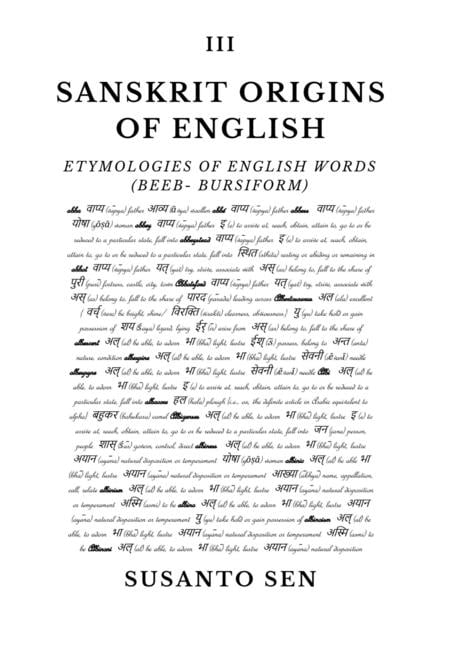
Sanskrit Origins of English: Etymologies of English Words (Beeb- bursiform) - Paperback
by Susanto Sen
$22.99
$25.95
-11%Quantity
01
Pay over time for orders over $35.00 with
Offers & Perks
Earn 22 points with this purchase
Added to your rewards balance after checkout.
100 points welcome bonus
Create an account and start with extra points.
Availability:In StockContributor:Susanto SenSeries:Sanskrit Origins of EnglishTheme:Cultural Region/BritishPublish date:7/10/2025Pages:552
Languages:EnglishPublisher:UṢā VijnaISBN-13:9789334299199ISBN-10:9334299193UPC:9789334299199Book Category:History, Language Arts & Disciplines, Literary CriticismBook Subcategory:Europe, Linguistics, Comparative LiteratureBook Topic:Great Britain, EtymologySize:10.00 x 7.00 x 1.12 inchesWeight:0.944Product ID:SCDD7DGSMW
This book delves into the Sanskrit origins of over 7400 English words, from beeb to bursiform, in alphabetical order. Examples of the Sanskrit origins of English words from this book:
beef 1. the meat of a cow, bull or ox. 2. strong muscular meat. (S) वाह्य (vāhya) ox + (S) उभ् (ubh) kill beefalo a hybrid cross between buffalo and cattle. (S) वाह्य (vāhya) ox + (S) बहुल (bahula) black beetlebrain a stupid or foolish person. (S) व्यत्ति (vyatti) bite through or on all sides + (S) अल् (al) be able + (S) प्राय (prāya) chief part, starting, anything prominent + (S) अयान (ayāna) natural disposition or temperament beggarwoman a woman who lives by begging for money or food. (S) भिक्ष् (bhikṣ) beg for + (S) एर् (ēr) raise, procure, obtain, bring near, cause to obtain + (S) अंमना (aṃmanā) woman berth 1. an attached bunk for sleeping in trains, caravans, etc. 2. a job or position in some types of employment. 3. a place or position for manoeuvring or mooring. (S) भरत् (bharat) bearing, carrying bight 1. a corner, bend, angle or hollow. 2. a bend, curve or promontory along a coastline. 3. a curve of a rope. (S) व्यती (vyatī) depart or deviate or swerve from, take an irregular course biyearly 1. occurring once every two years. 2. occurring twice a year. (S) वि (vi) asunder, apart [i.e., split into two] + (S) यर्हि (yarhi) at which time, since, when + (S) ली (lī) adhering, clinging to bluebird a small blue bird of North America, which is considered to be a symbol of hope, love, and renewal according to Native American legends. (S) बहुल (bahula) sky, indigo plant + (S) वियति (viyati) bird blur 1. to make or become less clear. 2. to see or hear less clearly. (S) विलय (vilaya) disappearance, destruction + (S) एर् (ēr) raise, procure, obtain, bring near, cause to obtain boody to sulk. (S) व्याति (vyāti) retire, withdraw bookhunter a person who searches for books to purchase. (S) वाक (vāka) text + (S) हन्तृ (hantṛ) slayer, killer bridecake a wedding cake. (S) भार्यात्व (bhāryātva) wifehood + (S) कुच् (kuc) make curved, be curved or crooked bulb 1. a rounded solid object which is tapered at one end. 2. a light bulb. 3. the bulb shaped roots of some plants. (S) बिल्व (bilva) stone apple fruit or Aegle marmelos burglar someone who secretly breaks into a building for stealing things. The word is cognate with British Medieval Latin burglātor, Old French burgeor, meaning "burglar," Medieval Latin burgātor, meaning "burglar," comprising of burgō, meaning "to commit burglary." (S) वृक् (vṛk) take, seize + (S) अल् (al) be able + (S) एर् (ēr) raise, procure, obtain, bring near, cause to obtain
beef 1. the meat of a cow, bull or ox. 2. strong muscular meat. (S) वाह्य (vāhya) ox + (S) उभ् (ubh) kill beefalo a hybrid cross between buffalo and cattle. (S) वाह्य (vāhya) ox + (S) बहुल (bahula) black beetlebrain a stupid or foolish person. (S) व्यत्ति (vyatti) bite through or on all sides + (S) अल् (al) be able + (S) प्राय (prāya) chief part, starting, anything prominent + (S) अयान (ayāna) natural disposition or temperament beggarwoman a woman who lives by begging for money or food. (S) भिक्ष् (bhikṣ) beg for + (S) एर् (ēr) raise, procure, obtain, bring near, cause to obtain + (S) अंमना (aṃmanā) woman berth 1. an attached bunk for sleeping in trains, caravans, etc. 2. a job or position in some types of employment. 3. a place or position for manoeuvring or mooring. (S) भरत् (bharat) bearing, carrying bight 1. a corner, bend, angle or hollow. 2. a bend, curve or promontory along a coastline. 3. a curve of a rope. (S) व्यती (vyatī) depart or deviate or swerve from, take an irregular course biyearly 1. occurring once every two years. 2. occurring twice a year. (S) वि (vi) asunder, apart [i.e., split into two] + (S) यर्हि (yarhi) at which time, since, when + (S) ली (lī) adhering, clinging to bluebird a small blue bird of North America, which is considered to be a symbol of hope, love, and renewal according to Native American legends. (S) बहुल (bahula) sky, indigo plant + (S) वियति (viyati) bird blur 1. to make or become less clear. 2. to see or hear less clearly. (S) विलय (vilaya) disappearance, destruction + (S) एर् (ēr) raise, procure, obtain, bring near, cause to obtain boody to sulk. (S) व्याति (vyāti) retire, withdraw bookhunter a person who searches for books to purchase. (S) वाक (vāka) text + (S) हन्तृ (hantṛ) slayer, killer bridecake a wedding cake. (S) भार्यात्व (bhāryātva) wifehood + (S) कुच् (kuc) make curved, be curved or crooked bulb 1. a rounded solid object which is tapered at one end. 2. a light bulb. 3. the bulb shaped roots of some plants. (S) बिल्व (bilva) stone apple fruit or Aegle marmelos burglar someone who secretly breaks into a building for stealing things. The word is cognate with British Medieval Latin burglātor, Old French burgeor, meaning "burglar," Medieval Latin burgātor, meaning "burglar," comprising of burgō, meaning "to commit burglary." (S) वृक् (vṛk) take, seize + (S) अल् (al) be able + (S) एर् (ēr) raise, procure, obtain, bring near, cause to obtain
Languages:EnglishPublisher:UṢā VijnaISBN-13:9789334299199ISBN-10:9334299193UPC:9789334299199Book Category:History, Language Arts & Disciplines, Literary CriticismBook Subcategory:Europe, Linguistics, Comparative LiteratureBook Topic:Great Britain, EtymologySize:10.00 x 7.00 x 1.12 inchesWeight:0.944Product ID:SCDD7DGSMW
Free shipping on orders over $75. Standard shipping takes 3-7 business days. Returns accepted within 30 days of purchase.