
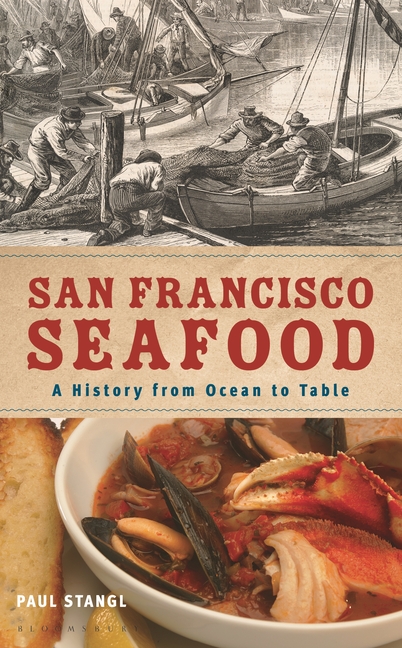
San Francisco Seafood: A History from Ocean to Table - Hardcover
by Paul Stangl
$39.99
Quantity
01
Pay over time for orders over $35.00 with
Offers & Perks
Earn 39 points with this purchase
Added to your rewards balance after checkout.
100 points welcome bonus
Create an account and start with extra points.
Availability:In StockContributor:Paul StanglTheme:Cultural Region/West Coast, Cultural Region/Western U.S., Geographic Orientation/CaliforniaPublish date:4/2/2026Pages:256
Languages:EnglishPublisher:Bloomsbury AcademicISBN-13:9798765145678UPC:9798765145678Book Category:CookingBook Subcategory:Specific Ingredients, History, Regional & CulturalBook Topic:Fish & Seafood, AmericanSize:9.08 x 6.35 x 0.81 inchesWeight:0.49Product ID:SCFV10S6DA
A deep dive into the history and evolution of San Francisco's seafood industry and what it teaches us about sustainability and cuisine today.
For early San Franciscans, seafood was an important source of nutrition and a feature of social life, inspiring culinary developments that remain components in California cuisine more than a century later. Consumers interested in flavorful alternatives to meat and associated health benefits could follow recipes for nearly fifty types of marine life from state waters, such as salmon, flounder, and oysters. Others are no longer available, out-of-vogue, or simply forgotten. Further, overfishing and environmental damage decimated many local seafood stocks, providing a cautionary tale with global significance.
In San Francisco Seafood: A History from Ocean to Table, Paul Stangltraces the development of San Francisco's fisheries, seafood markets, cookery, and dining culture from the Gold Rush to the 1920s. Migrants from around the world imported fishing techniques and cuisines, then slowly adapted as they came to understand local resources and each other. Newcomers found the tastiest fish through trial and error and assimilated the into a new cuisine. Different ethnic and occupational groups collaborated, fought, and learned from one another as they irreversibly altered the natural world around them. By the end of the First World War, San Francisco's seafood cuisine scarcely resembled that of the 1850s, due to cultural adaptation, technological advancements, and changes to the natural environment. It was no longer derivative of New England and France, but included influences from the Southern states, Asia, and South America.
San Francisco Seafoodchronicles the city's transformation from a fish-barren town-where restaurants served canned, pickled, and dried fish from the East Coast-to a seafood-rich metropolis that harvested seafood from Mexico to Alaska. He emphasizes how the impacts on nature and local labor serve as a necessary cautionary tale for today's global seafood trade. This is a thorough and insightful history of a once emerging, and now essential, cuisine for food and history buffs alike.
For early San Franciscans, seafood was an important source of nutrition and a feature of social life, inspiring culinary developments that remain components in California cuisine more than a century later. Consumers interested in flavorful alternatives to meat and associated health benefits could follow recipes for nearly fifty types of marine life from state waters, such as salmon, flounder, and oysters. Others are no longer available, out-of-vogue, or simply forgotten. Further, overfishing and environmental damage decimated many local seafood stocks, providing a cautionary tale with global significance.
In San Francisco Seafood: A History from Ocean to Table, Paul Stangltraces the development of San Francisco's fisheries, seafood markets, cookery, and dining culture from the Gold Rush to the 1920s. Migrants from around the world imported fishing techniques and cuisines, then slowly adapted as they came to understand local resources and each other. Newcomers found the tastiest fish through trial and error and assimilated the into a new cuisine. Different ethnic and occupational groups collaborated, fought, and learned from one another as they irreversibly altered the natural world around them. By the end of the First World War, San Francisco's seafood cuisine scarcely resembled that of the 1850s, due to cultural adaptation, technological advancements, and changes to the natural environment. It was no longer derivative of New England and France, but included influences from the Southern states, Asia, and South America.
San Francisco Seafoodchronicles the city's transformation from a fish-barren town-where restaurants served canned, pickled, and dried fish from the East Coast-to a seafood-rich metropolis that harvested seafood from Mexico to Alaska. He emphasizes how the impacts on nature and local labor serve as a necessary cautionary tale for today's global seafood trade. This is a thorough and insightful history of a once emerging, and now essential, cuisine for food and history buffs alike.
Languages:EnglishPublisher:Bloomsbury AcademicISBN-13:9798765145678UPC:9798765145678Book Category:CookingBook Subcategory:Specific Ingredients, History, Regional & CulturalBook Topic:Fish & Seafood, AmericanSize:9.08 x 6.35 x 0.81 inchesWeight:0.49Product ID:SCFV10S6DA
Paul Stangl has published broadly in urban history and geography with a focus on San Francisco, California and Berlin, Germany. He is a seafood enthusiast who enjoys expanding his knowledge by reading, shopping at fish markets, and eating at new restaurants in cities around the world. He currently resides in Seattle, Washington.
Publisher: Bloomsbury Academic
Contributor(s)
Author
Free shipping on orders over $75. Standard shipping takes 3-7 business days. Eligible items may be returned within 30 days of delivery. Conditions apply.