
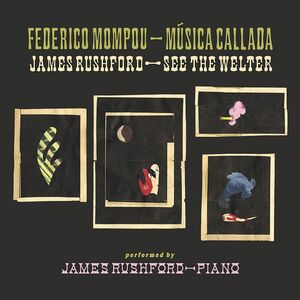
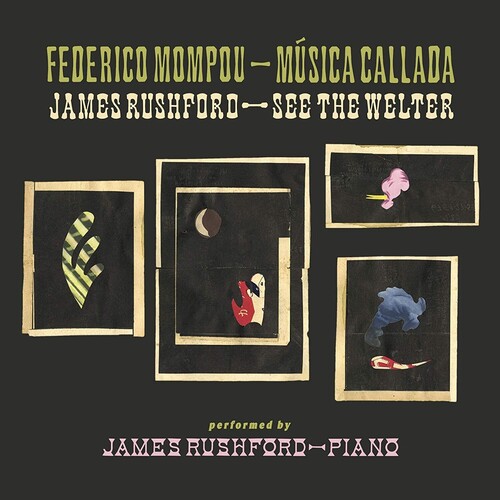
Musica Callada / See The Welter - CD
$12.99
$14.98
-13%Quantity
01
Pay over time for orders over $35.00 with
Offers & Perks
Earn 12 points with this purchase
Added to your rewards balance after checkout.
100 points welcome bonus
Create an account and start with extra points.
Availability:In StockArtist:James RushfordGenre:Classical ArtistsRelease date:10/30/2020Original year:2020
Publisher:Unseen WorldsLabel:Unseen WorldsUPC:744790142839Weight:0.18Discs:2Product ID:SCVGPWSXS1
The imagery of musical forms emptied of earthly meaning, of solitude, and of a connection to the divine were irresistible to Federico Mompou. A desire to be alone had shaped Mompou's early musical direction: as natural shyness ended his ambitions to be piano virtuoso, after studies at the Paris Conservatoire he turned to composition instead. His approach remained introspective - far removed from the overt and public expressions of the avant-garde, both before and after the Second World War - and pursued a line inwards, towards Catalan traditional music, idiosyncratic technique, and a spiritually clarified instinctivism inspired particularly by Erik Satie. The four books of pieces are considered by some to be Mompou's masterpiece. Música callada creates a sort of musical negative space, in which presence (of external references) creates lightness, and absence (of formal complexity, of counterpoint, of thematic or harmonic development) creates weight and substance. Metaphors such as these also lie behind James Rushford's See the Welter, composed as a companion piece to Música callada in 2016. In See the Welter, Rushford introduces a concept of 'musical shadows'. The aim is not a recognisable transcription or recomposition of Mompou's twenty-eight pieces, but a sort of Proustian 'sieving', in which memories and sensations - such as finger pressures, resonances and harmonic rhythm - are projected across a new surface, in new forms, and as new memories. Just as a shadow both intensifies and diffuses the form of the object by which it is cast, so Rushford's piece transforms and scatters the details of Mompou's collection while intensifying it's essence. Compositionally, the piece is the inverse of Mompou's: a single block in place of a multitude of fleeting impressions; it's long shadow. Expressively, however, See the Welter explores the same territory, if seen through the other side of the glass: resonances and absences, silences within sounds, luminosity and intensity, bodies within spaces.
Publisher:Unseen WorldsLabel:Unseen WorldsUPC:744790142839Weight:0.18Discs:2Product ID:SCVGPWSXS1
Publisher: Unseen Worlds
Label: Unseen Worlds
Artist(s)
Free shipping on orders over $75. Standard shipping takes 3-7 business days. Eligible items may be returned within 30 days of delivery. Conditions apply.