
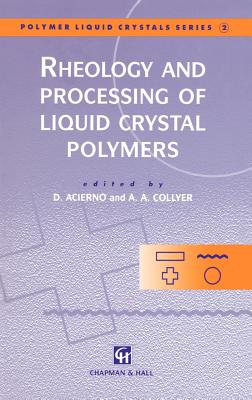
Rheology and Processing of Liquid Crystal Polymers - Hardcover
$217.99
$219.99
-1%Quantity
01
Pay over time for orders over $35.00 with
Offers & Perks
Earn 217 points with this purchase
Added to your rewards balance after checkout.
100 points welcome bonus
Create an account and start with extra points.
Availability:In StockContributor:Domenico Acierno, A. A. CollyerSeries:Polymer Liquid CrystalsPublish date:8/31/1996Pages:318
Languages:EnglishPublisher:SpringerISBN-13:9780412596407ISBN-10:0412596407UPC:9780412596407Book Category:Technology & Engineering, ScienceBook Subcategory:Materials Science, Textiles & Polymers, ChemistryBook Topic:Physical & TheoreticalSize:9.49 x 6.41 x 0.78 inchesWeight:0.549Product ID:SC5SF0KEFA
Liquid crystal polymers (LCPs) have many strange properties that may be utilized to advantage in the processing of products made from them and their blends with isotropic polymers. This volume (volume 2 in the series Polymer Liquid Crystals) deals with their strange flow behaviour and the models put forward to explain the phenomena that occur in such polymers and their blends. It has been known for some time that small ad- ditions of a thermotropic LCP to isotropic polymers not only gives an improvement in the strength and stiffness of the blend but improves the processability of the blend over that of the isotropic polymer. In the case of lyotropic LCPs, it is possible to create a molecular composite in which the reinforcement of an isotropic polymer is achieved at a molecular level by the addition of the LCP in a common solvent. If the phenomena can be fully understood both the reinforcement and an increase in the proces- sability of isotropic polymers could be optimized. This book is intended to illustrate the current theories associated with the flow of LCPs and their blends in the hope that such an optimization will be achieved by future research. Chapter 1 introduces the subject of LCPs and describes the ter- minology used; Chapter 2 then discusses the more complex phenomena associated with these materials. In Chapter 3, the way in which these phe- nomena may be modelled using hamiltonians is fully covered.
Languages:EnglishPublisher:SpringerISBN-13:9780412596407ISBN-10:0412596407UPC:9780412596407Book Category:Technology & Engineering, ScienceBook Subcategory:Materials Science, Textiles & Polymers, ChemistryBook Topic:Physical & TheoreticalSize:9.49 x 6.41 x 0.78 inchesWeight:0.549Product ID:SC5SF0KEFA
Publisher: Springer
Edition
1996 Edition
Contributor(s)
Free shipping on orders over $75. Standard shipping takes 3-7 business days. Returns accepted within 30 days of purchase.