
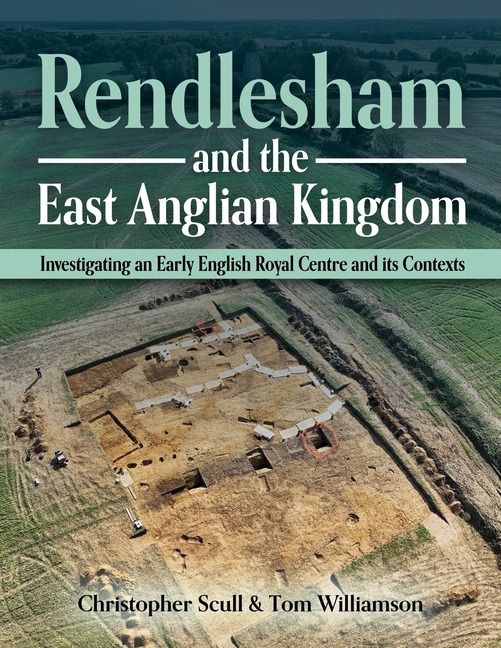
Rendlesham and the East Anglian Kingdom: Investigating an Early English Royal Centre and Its Contexts - Paperback
$51.99
$59.99
-13%Quantity
01
Pay over time for orders over $35.00 with
Offers & Perks
Earn 51 points with this purchase
Added to your rewards balance after checkout.
100 points welcome bonus
Create an account and start with extra points.
Availability:In StockContributor:Christopher Scull, Tom WilliamsonTheme:Chronological Period/Ancient (To 499 A.D.), Cultural Region/BritishPublish date:5/31/2026Pages:240
Languages:EnglishPublisher:Windgather PressISBN-13:9781914427312ISBN-10:1914427319UPC:9781914427312Book Category:Social Science, HistoryBook Subcategory:Archaeology, Europe, AncientBook Topic:Great BritainSize:9.61 x 7.21 x 0.71 inchesWeight:0.658Product ID:SC8X97ABAA
Explores the rediscovery of Rendlesham, revealing its role in early East Anglian power.
Lost for centuries, the site of the East Anglian royal settlement at Rendlesham is now giving up its secrets. Noted by the Venerable Bede as a place of royal baptism in the seventh century CE, its location has been pin-pointed and its archaeology investigated. The settlement flourished from the early fifth century CE, but was at its peak between the late sixth and early eighth centuries - when it was larger and wealthier than any other of the time yet known in England. Rendlesham was then the centre of a major region of the East Anglian kingdom, a residence of the East Anglian ruling family - the Wuffings. Members of the royal kindred were buried at the princely burial grounds at Snape and Sutton Hoo, which were part of the same landscape of power.
Rendlesham cannot be fully understood in isolation. There are other comparable sites in East Anglia that also appear to have been centres of wealth and power, set in their own discrete territories. Were these originally the residences of independent local leaders who were eventually dominated by the rulers of Rendlesham? Or were the latter dominant from the start, perhaps taking over the Roman civitas of the Iceni? Such questions go to the heart of current debates about the forces that shaped early England.
This book tells the story of the initial discovery and subsequent archaeological investigations at Rendlesham, and places the site in its broader context as a focus of power in the early East Anglian kingdom. It considers the approaches in archaeology and landscape history that were used - including systematic metal detecting - and highlights the extraordinary results that off er new perspectives on early English society and the origins of the English kingdoms.
Lost for centuries, the site of the East Anglian royal settlement at Rendlesham is now giving up its secrets. Noted by the Venerable Bede as a place of royal baptism in the seventh century CE, its location has been pin-pointed and its archaeology investigated. The settlement flourished from the early fifth century CE, but was at its peak between the late sixth and early eighth centuries - when it was larger and wealthier than any other of the time yet known in England. Rendlesham was then the centre of a major region of the East Anglian kingdom, a residence of the East Anglian ruling family - the Wuffings. Members of the royal kindred were buried at the princely burial grounds at Snape and Sutton Hoo, which were part of the same landscape of power.
Rendlesham cannot be fully understood in isolation. There are other comparable sites in East Anglia that also appear to have been centres of wealth and power, set in their own discrete territories. Were these originally the residences of independent local leaders who were eventually dominated by the rulers of Rendlesham? Or were the latter dominant from the start, perhaps taking over the Roman civitas of the Iceni? Such questions go to the heart of current debates about the forces that shaped early England.
This book tells the story of the initial discovery and subsequent archaeological investigations at Rendlesham, and places the site in its broader context as a focus of power in the early East Anglian kingdom. It considers the approaches in archaeology and landscape history that were used - including systematic metal detecting - and highlights the extraordinary results that off er new perspectives on early English society and the origins of the English kingdoms.
Languages:EnglishPublisher:Windgather PressISBN-13:9781914427312ISBN-10:1914427319UPC:9781914427312Book Category:Social Science, HistoryBook Subcategory:Archaeology, Europe, AncientBook Topic:Great BritainSize:9.61 x 7.21 x 0.71 inchesWeight:0.658Product ID:SC8X97ABAA
Williamson, Tom: - Tom Williamson is Emeritus Professor of Landscape History at the University of East Anglia and has written widely on historical ecology, landscape archaeology and the history of landscape design.Scull, Christopher: - Christopher Scull is an archaeologist with research interests in the early medieval societies of north-west Europe and has helped guide survey and excavation at Rendlesham since 2012. He is an Honorary Visiting Professor at the School of History, Archaeology and Religion, Cardiff University, and the Institute of Archaeology, University College London.
Publisher: Windgather Press
Contributor(s)
Authors
Free shipping on orders over $75. Standard shipping takes 3-7 business days. Eligible items may be returned within 30 days of delivery. Conditions apply.