
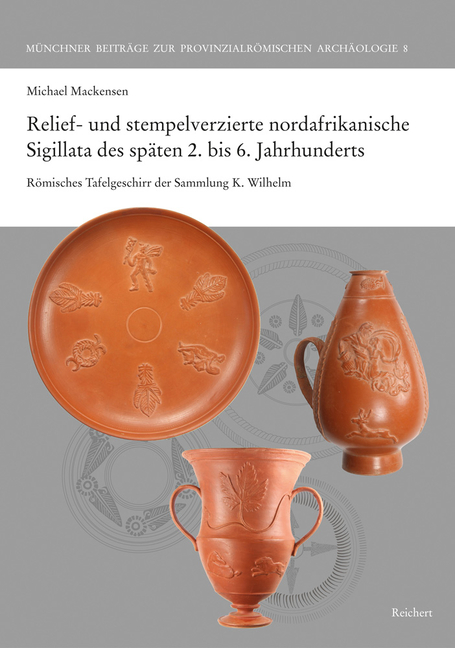
Relief- Und Stempelverzierte Nordafrikanische Sigillata Des Späten 2. Bis 6. Jahrhunderts: Römisches Tafelgeschirr Der Sammlung K. Wilhelm - Hardcover
$161.99
Quantity
01
Pay over time for orders over $35.00 with
Offers & Perks
Earn 161 points with this purchase
Added to your rewards balance after checkout.
100 points welcome bonus
Create an account and start with extra points.
Availability:In StockContributor:Michael MackensenSeries:M?nchner Beitr?ge Zur Provinzialr?mischen Arch?ologieTheme:Chronological Period/Ancient (To 499 A.D.), Cultural Region/ItalyPublish date:11/22/2019Pages:596
Languages:GermanPublisher:Dr Ludwig Reichert VerlagISBN-13:9783954904136ISBN-10:3954904136UPC:9783954904136Book Category:Art, HistoryBook Subcategory:History, Ceramics, AncientBook Topic:Ancient & Classical, RomeSize:12.01 x 8.61 x 1.81 inchesWeight:2.942Product ID:SCZKQ2Y0RS
The study presents a summary of the development over 500 years of the high-quality North African red slip ware, a fineware which was mainly used as tableware. The masterful handicraft of several large pottery production centres in one of Rome's economically most important provinces, Africa Proconsularis, is particularly well reflected in the exceptional relief-decorated wares. The study focuses on the rare appliqué-decorated north Tunisian red slip ware of the late 2nd/early 3rd century and also the wide range of forms and decorations of the appliqué-, relief- and stamp-decorated red slip ware of the early 3rd to mid 6th century, produced in Sidi Marzouk Tounsi, the most important pottery production centre in central Tunisia which operated for at least 350 years. Production at this site included lamps and terracotta figurines in red slip ware as well, but in particular a wide variety of plain and decorated red slip ware vessels made not only for a regional market, but for Mediterranean long-distance trade.
Research is based on the exceptionally extensive collection accumulated by K. Wilhelm mainly between 1960 and 1995. The material is presented in a catalogue containing 138 vessels and 104 fragments, including several unique vessel forms and a series of unknown appliqués and stamp types. For comparison, some important, but partially unpublished vessels and fragments in several European, North American and North African museums and private collections were additionally taken into account.
For the first time, the decoration schemes and also the vessel forms of an appliqué-decorated pottery produced in a north-eastern and in another central Tunisian production centre throughout the late 2nd and 3rd century, are classified and clearly represented. The research also succeeded in defining the late phase of the so-called El Aouja ware and highlights the stylistic development leading to the appliqué-decorated red slip ware of the 4th century. Moreover, the analysis of the appliqué and relief decoration with pagan, allegoric and early Christian motifs emphasises an iconographic transformation over the centuries based on the visible change in the figural scenes. Of utmost importance is the fact that the production centre at Sidi Marzouk Tounsi clearly survived the Vandal rule of the provinces Africa and Byzacena (429-533/534). Alongside the late relief-decorated red slip wares, there is now also evidence for the production of mould-made, relief-decorated red slip ware platters and several specific forms with mainly Christian motifs, far exceeding the previously suggested end of production (c. 430/440) and suggesting an end around the middle of the 6th century.
Research is based on the exceptionally extensive collection accumulated by K. Wilhelm mainly between 1960 and 1995. The material is presented in a catalogue containing 138 vessels and 104 fragments, including several unique vessel forms and a series of unknown appliqués and stamp types. For comparison, some important, but partially unpublished vessels and fragments in several European, North American and North African museums and private collections were additionally taken into account.
For the first time, the decoration schemes and also the vessel forms of an appliqué-decorated pottery produced in a north-eastern and in another central Tunisian production centre throughout the late 2nd and 3rd century, are classified and clearly represented. The research also succeeded in defining the late phase of the so-called El Aouja ware and highlights the stylistic development leading to the appliqué-decorated red slip ware of the 4th century. Moreover, the analysis of the appliqué and relief decoration with pagan, allegoric and early Christian motifs emphasises an iconographic transformation over the centuries based on the visible change in the figural scenes. Of utmost importance is the fact that the production centre at Sidi Marzouk Tounsi clearly survived the Vandal rule of the provinces Africa and Byzacena (429-533/534). Alongside the late relief-decorated red slip wares, there is now also evidence for the production of mould-made, relief-decorated red slip ware platters and several specific forms with mainly Christian motifs, far exceeding the previously suggested end of production (c. 430/440) and suggesting an end around the middle of the 6th century.
Languages:GermanPublisher:Dr Ludwig Reichert VerlagISBN-13:9783954904136ISBN-10:3954904136UPC:9783954904136Book Category:Art, HistoryBook Subcategory:History, Ceramics, AncientBook Topic:Ancient & Classical, RomeSize:12.01 x 8.61 x 1.81 inchesWeight:2.942Product ID:SCZKQ2Y0RS
Michael Mackensen (*1949) studied Archaeology of the Roman Provinces, Prehistory and Ancient History at Munich, Freiburg and Oxford from 1969 until 1977. After his MA (1974), PhD (1977) and a travel scholarship granted by the German Archaeological Institute/DAI (1977/78) he participated in excavations of the DAI at Carthage (Tunisia) and Resafa (Syria). From 1982 to 1994 he was research assistant at the Bavarian Academy of Sciences conducting excavations in Bavaria (e. g. Nersingen, Kellmünz) and a survey project at El Mahrine (Tunisia). In 1991 he submitted his habilitation thesis and then became Professor for Archaeology of the Roman Provinces at the Ludwig-Maximilians University of Munich in 1994. He carried out various field projects in Bavaria (2001-2007 Burghöfe), Tunisia (1998/99 Chemtou), Egypt (2001/02 Deir el-Bakhît; 2005-2017 Nag al-Hagar) and Libya (2009/10 Gheriat el-Garbia, LMUexcellent-Project limes Tripolitanus). In 1989 he was allocated with the Kurt-Bittel-Preis für Süddeutsche Altertumskunde, in 2010 with the Preis für gute Lehre des Freistaats Bayern and in 2013 with the LMU Lehrinnovationspreis. In March 2015 he was retired.
Publisher: Dr Ludwig Reichert Verlag
Contributor(s)
Author
Free shipping on orders over $75. Standard shipping takes 3-7 business days. Eligible items may be returned within 30 days of delivery. Conditions apply.