
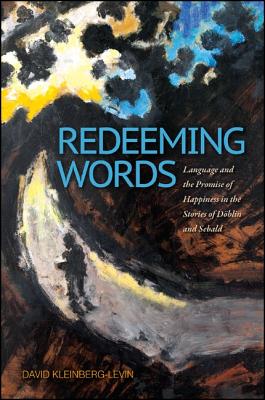
Redeeming Words: Language and the Promise of Happiness in the Stories of Döblin and Sebald - Hardcover
Pay over time for orders over $35.00 with
Offers & Perks
Earn 108 points with this purchase
Added to your rewards balance after checkout.
100 points welcome bonus
Create an account and start with extra points.
Probing study of how literature can redeem the revelatory, redemptive powers of language.
In this probing look at Alfred Döblin's 1929 novel Berlin Alexanderplatz and the stories of W. G. Sebald, Redeeming Words offers a philosophical meditation on the power of language in literature. David Kleinberg-Levin draws on the critical theory of Benjamin and Adorno; the idealism and romanticism of Kant, Hegel, Hölderlin, Novalis, and Schelling; and the nineteenth- and twentieth-century thought of Nietzsche, Heidegger, and Derrida. He shows how Döblin and Sebald-writers with radically different styles working in different historical moments-have in common a struggle against forces of negativity and an aim to bring about in response a certain redemption of language. Kleinberg-Levin considers the fast-paced, staccato, and hard-cut sentences of Döblin and the ghostly, languorous, and melancholy prose fiction of Sebald to articulate how both writers use language in an attempt to recover and convey this utopian promise of happiness for life in a time of mourning.
David Kleinberg-Levin is Professor Emeritus of Philosophy at Northwestern University. His many books include Gestures of Ethical Life: Reading Hölderlin's Question of Measure After Heidegger; Before the Voice of Reason: Echoes of Responsibility in Merleau-Ponty's Ecology and Levinas's Ethics, also published by SUNY Press; and Redeeming Words and the Promise of Happiness: A Critical Theory Approach to Wallace Stevens and Vladimir Nabokov.
Contributor(s)
Free shipping on orders over $75. Standard shipping takes 3-7 business days. Eligible items may be returned within 30 days of delivery. Conditions apply.