
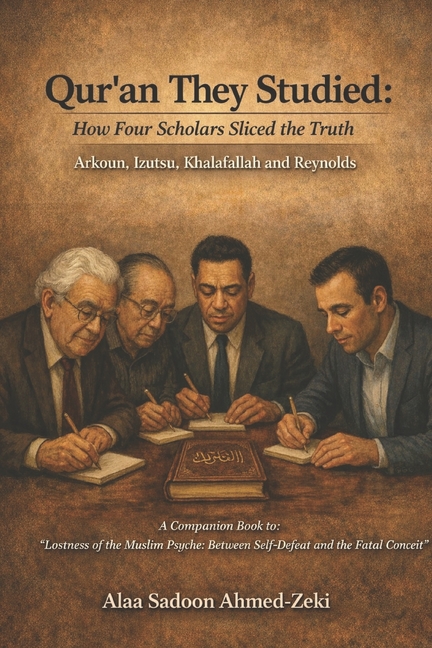
Qur'an They Studied: How Four Scholars Sliced the Truth: Arkoun, Izutsu, Khalafallah and Reynolds - Paperback
$22.99
$25.95
-11%Quantity
01
Pay over time for orders over $35.00 with
Offers & Perks
Earn 22 points with this purchase
Added to your rewards balance after checkout.
100 points welcome bonus
Create an account and start with extra points.
Availability:In StockContributor:Alaa Sadoon Ahmed-ZekiTheme:Religious Orientation/IslamicPublish date:4/18/2026Pages:152
Languages:EnglishPublisher:Alaa Sadoon Ahmed-ZekiISBN-13:9781764642507ISBN-10:1764642503UPC:9781764642507Book Category:Social Science, ReligionBook Subcategory:Islamic Studies, Islam, PhilosophyBook Topic:TheologySize:9.00 x 6.00 x 0.35 inchesWeight:0.213Product ID:SCXDYK30R7
Why does the most rigorous modern scholarship stop at the threshold of the sacred?
Qur'an They Studied: How Four Scholars Sliced the Truth exposes a devastating pattern hiding in plain sight. Four of the most influential scholars of the last century-Mohammed Arkoun, Toshihiko Izutsu, Mohammed Ahmad Khalafallah, and Gabriel Said Reynolds-produced evidence that fundamentally undermines the Qur'an's claim to divine perfection.
Then, they refused to say so.
Using post-structural critique, semantic mapping, literary theory, and historical-critical analysis, these scholars reveal a consistent reality from different angles: internal tensions, constructed authority, and clear dependence on earlier human traditions. The evidence converges, yet the conclusions remain intentionally amputated. They map the architecture of the "prison" with clinical precision, but refuse to name the architect.
The analysis is rigorous; the silence is deliberate.
In this uncompromising "forensic audit," Alaa Sadoon Ahmed-Zeki removes that silence. Utilizing Critical Discourse Analysis (CDA), this book turns to the one question the academy has systematically avoided: The Speaker.
By moving beyond what the Qur'an says to what its own language reveals about the voice behind it-its commands, threats, self-assertions, and moral logic-the persona of the Speaker finally becomes visible, and accountable.
Inside this study, you will discover:
This book finishes the argument they started-and stopped.
A Companion Book to "Lostness of the Muslim Psyche: Between Self-Defeat and the Fatal Conceit."
Qur'an They Studied: How Four Scholars Sliced the Truth exposes a devastating pattern hiding in plain sight. Four of the most influential scholars of the last century-Mohammed Arkoun, Toshihiko Izutsu, Mohammed Ahmad Khalafallah, and Gabriel Said Reynolds-produced evidence that fundamentally undermines the Qur'an's claim to divine perfection.
Then, they refused to say so.
Using post-structural critique, semantic mapping, literary theory, and historical-critical analysis, these scholars reveal a consistent reality from different angles: internal tensions, constructed authority, and clear dependence on earlier human traditions. The evidence converges, yet the conclusions remain intentionally amputated. They map the architecture of the "prison" with clinical precision, but refuse to name the architect.
The analysis is rigorous; the silence is deliberate.
In this uncompromising "forensic audit," Alaa Sadoon Ahmed-Zeki removes that silence. Utilizing Critical Discourse Analysis (CDA), this book turns to the one question the academy has systematically avoided: The Speaker.
By moving beyond what the Qur'an says to what its own language reveals about the voice behind it-its commands, threats, self-assertions, and moral logic-the persona of the Speaker finally becomes visible, and accountable.
Inside this study, you will discover:
- The Epistemological Detour: How scholars use "sophisticated rethinking" as an analgesic for cognitive dissonance.
- The Aesthetic Alibi: How historical errors are rebranded as "literary genius" to protect sacred immunity.
- The Interrogation of the Voice: A total ontological rupture that moves from how the text functions to what the being behind the text actually reveals about itself.
This book finishes the argument they started-and stopped.
A Companion Book to "Lostness of the Muslim Psyche: Between Self-Defeat and the Fatal Conceit."
Languages:EnglishPublisher:Alaa Sadoon Ahmed-ZekiISBN-13:9781764642507ISBN-10:1764642503UPC:9781764642507Book Category:Social Science, ReligionBook Subcategory:Islamic Studies, Islam, PhilosophyBook Topic:TheologySize:9.00 x 6.00 x 0.35 inchesWeight:0.213Product ID:SCXDYK30R7
Free shipping on orders over $75. Standard shipping takes 3-7 business days. Eligible items may be returned within 30 days of delivery. Conditions apply.