
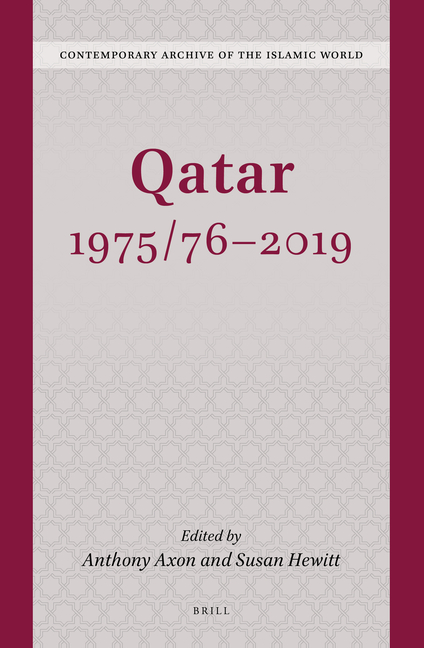
Qatar 1975/76-2019 - Hardcover
$311.99
Quantity
01
Pay over time for orders over $35.00 with
Offers & Perks
Earn 311 points with this purchase
Added to your rewards balance after checkout.
100 points welcome bonus
Create an account and start with extra points.
Availability:In StockContributor:Anthony Axon, Susan HewittSeries:Contemporary Archive of the Islamic WorldTheme:Cultural Region/Asian, Cultural Region/Middle EasternPublish date:9/24/2020Pages:472
Languages:EnglishPublisher:BrillISBN-13:9789004444324ISBN-10:9004444327UPC:9789004444324Book Category:Political Science, HistoryBook Subcategory:International Relations, Asia, Middle EastSize:9.30 x 6.10 x 1.20 inchesWeight:0.795Product ID:SCA891W0HW
The fourth in this series, the Contemporary Archive of the Islamic World (CAIW), this title draws on the resources of Cambridge-based World of Information, which since 1975 has followed the politics and economics of the region. Qatar's documented history begins in the mid-19th Century. Its location established it as having close, if differing links to Bahrain, Kuwait and Saudi Arabia.
Notionally under Ottoman rule, Qatar did not become a de facto protectorate of Great Britain until some time after the end of the Ottoman empire. The discovery of oil in Qatar happened later than was the case with its neighbours. However, the discovery of substantial oil deposits, and later of enormous gas reserves changed Qatar beyond recognition, allowing it to claim in the 1980s that its inhabitants were the richest people on earth. Still a semi-feudal monarchy, it gained full independence in 1971 but was initially considered to be the least developed state in the Gulf. By the 21st century many close neighbours felt that in a number of respects Qatar was becoming an unreliable partner. To the extent that in 2017 a number of its fellow Gulf Cooperation Council (GCC) members, as well as other states - notably Egypt - broke off diplomatic relations.
Notionally under Ottoman rule, Qatar did not become a de facto protectorate of Great Britain until some time after the end of the Ottoman empire. The discovery of oil in Qatar happened later than was the case with its neighbours. However, the discovery of substantial oil deposits, and later of enormous gas reserves changed Qatar beyond recognition, allowing it to claim in the 1980s that its inhabitants were the richest people on earth. Still a semi-feudal monarchy, it gained full independence in 1971 but was initially considered to be the least developed state in the Gulf. By the 21st century many close neighbours felt that in a number of respects Qatar was becoming an unreliable partner. To the extent that in 2017 a number of its fellow Gulf Cooperation Council (GCC) members, as well as other states - notably Egypt - broke off diplomatic relations.
Languages:EnglishPublisher:BrillISBN-13:9789004444324ISBN-10:9004444327UPC:9789004444324Book Category:Political Science, HistoryBook Subcategory:International Relations, Asia, Middle EastSize:9.30 x 6.10 x 1.20 inchesWeight:0.795Product ID:SCA891W0HW
Anthony Axon, M.A. (Cantab) joined The Economist in 1967 to work on a Latin American Edition. He subsequently worked for the publishing division of the Council of Europe in Strasbourg before launching World of Information in 1973 in Cambridge, UK. Susan Hewitt first worked in publishing in 1963 in Lusaka, Northern Rhodesia (which became Zambia on independence in 1964). She worked with Gemini News Service soon after it launched in 1967 and then African Development Magazine. She joined World of Information in 1974.
Publisher: Brill
Contributor(s)
Free shipping on orders over $75. Standard shipping takes 3-7 business days. Eligible items may be returned within 30 days of delivery. Conditions apply.