
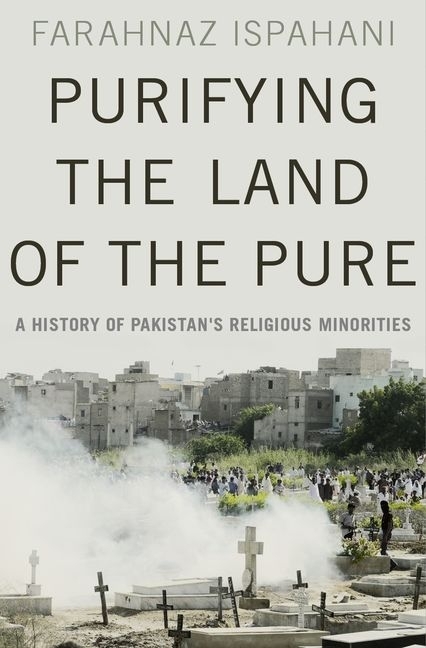
Purifying the Land of the Pure: A History of Pakistan's Religious Minorities - Hardcover
$33.99
$41.99
-19%Quantity
01
Pay over time for orders over $35.00 with
Offers & Perks
Earn 33 points with this purchase
Added to your rewards balance after checkout.
100 points welcome bonus
Create an account and start with extra points.
Availability:In StockContributor:Farahnaz IspahaniTheme:Chronological Period/1940's, Chronological Period/1950-1999, Chronological Period/21st Century, Cultural Region/Asian, Cultural Region/Indian, Cultural Region/Middle Eastern, Religious Orientation/IslamicPublish date:2/1/2017Pages:224
Languages:EnglishPublisher:Oxford University PressISBN-13:9780190621650ISBN-10:0190621656UPC:9780190621650Book Category:History, ReligionBook Subcategory:Asia, Religious Intolerance, Persecution & Conflict, IslamBook Topic:South, HistorySize:9.40 x 6.20 x 1.00 inchesWeight:0.44Product ID:SC481DY0D5
When Pakistan emerged as an independent state in 1947, it sought to provide a new homeland and safe harbor for South Asia's Muslims, the largest religious minority in the subcontinent at the time. Yet this project was not exclusive. Taking its name from Pakstan, an acronym composed of the key letters of its constituent regions-Punjab, Afghania, Kashmir, Sindh, and Baluchistan-Pakistan at first welcomed all of its new citizens, Muslim and non-Muslim alike. Non-Muslims comprised 23 percent of the total population, and non-Sunnis comprised a quarter of the Muslim population. Today, non-Muslims comprise a mere 3 percent of the population, and in recent years all non-Sunnis have been subjected to increasing levels of persecution and violence. What happened? In Purifying the Land of the Pure, Farahnaz Ispahani analyzes Pakistan's policies towards its religious minority populations, beginning from the time of independence in 1947. She notes the period of transition from an inclusive policy to an exclusive one, citing the influence of a number of religious and political leaders who invoked a new vision for Pakistan. The word "pakistan" is Urdu for "Land of the Pure"; thus, in their view, it followed that the objective for Pakistan's creation should be more specific and narrow: to create an Islamic State. In 1949, Pakistan's Constituent Assembly ratified this objective, which set the country on the path it was to follow. But as Ispahani carefully notes, the event that accelerated the pace towards intolerance of non-Sunnis was General Zia-ul-Haq's forceful ascent to power in 1977. His military regime promoted Sunni Islam at the expense of other denominations so that by the end of his reign, Pakistan was no longer a welcome place for minorities. Many fled, but those who remained faced escalating persecution, from both state and non-state actors. Tens of thousands died in the ensuing "purifying" attacks. Ispahani traces this history, stressing how the contradictions at the heart of the Pakistani state-building project have fueled the intolerance. Concise yet sweeping in its coverage, Purifying the Land of the Pure is essential reading for anyone interested in understanding why Pakistan remains plagued by radicalism and violence.
Languages:EnglishPublisher:Oxford University PressISBN-13:9780190621650ISBN-10:0190621656UPC:9780190621650Book Category:History, ReligionBook Subcategory:Asia, Religious Intolerance, Persecution & Conflict, IslamBook Topic:South, HistorySize:9.40 x 6.20 x 1.00 inchesWeight:0.44Product ID:SC481DY0D5
Farahnaz Ispahani is an author, journalist, politician, and policy analyst. She is a former Public Policy Scholar at the Woodrow Wilson Center, and served as a member of the National Assembly of Pakistan between 2008 and 2012.
Publisher: Oxford University Press
Contributor(s)
Author
Free shipping on orders over $75. Standard shipping takes 3-7 business days. Eligible items may be returned within 30 days of delivery. Conditions apply.