
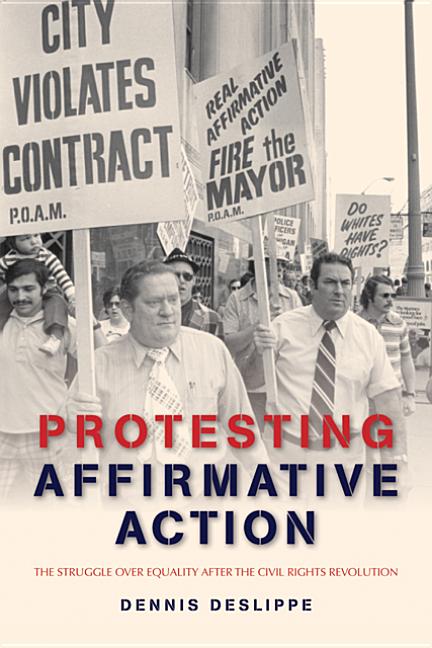
Protesting Affirmative Action: The Struggle Over Equality After the Civil Rights Revolution - Paperback
$37.99
Quantity
01
Pay over time for orders over $35.00 with
Offers & Perks
Earn 37 points with this purchase
Added to your rewards balance after checkout.
100 points welcome bonus
Create an account and start with extra points.
Availability:In StockContributor:Dennis DeslippeSeries:Reconfiguring American Political HistoryTheme:Ethnic Orientation/African American, Topical/Black HistoryPublish date:2/18/2014Pages:296
Languages:EnglishPublisher:Johns Hopkins University PressISBN-13:9781421413709ISBN-10:1421413701UPC:9781421413709Book Category:Social Science, HistoryBook Subcategory:Discrimination (incl. Prejudice, Racism, Colorism, etc.), United States, African American & BlackSize:8.90 x 6.00 x 0.80 inchesWeight:0.409Product ID:SC69AX2KKG
A lightning rod for liberal and conservative opposition alike, affirmative action has proved one of the more divisive issues in the United States over the past five decades. Dennis Deslippe here offers a thoughtful study of early opposition to the nation's race- and gender-sensitive hiring and promotion programs in higher education and the workplace. This story begins more than fifteen years before the 1978 landmark U.S. Supreme Court case Regents of the University of California v. Bakke. Partisans attacked affirmative action almost immediately after it first appeared in the 1960s. Liberals in the opposition movement played an especially significant role. While not completely against the initiative, liberal opponents strove for "soft" affirmative action (recruitment, financial aid, remedial programs) and against "hard" affirmative action (numerical goals, quotas). In the process of balancing ideals of race and gender equality with competing notions of colorblindness and meritocracy, they even borrowed the language of the civil rights era to make far-reaching claims about equality, justice, and citizenship in their anti-affirmative action rhetoric. Deslippe traces this conflict through compelling case studies of real people and real jobs. He asks what the introduction of affirmative action meant to the careers and livelihoods of Seattle steelworkers, New York asbestos handlers, St. Louis firemen, Detroit policemen, City University of New York academics, and admissions counselors at the University of Washington Law School. Through their experiences, Deslippe examines the diverse reactions to affirmative action, concluding that workers had legitimate grievances against its hiring and promotion practices. In studying this phenomenon, Deslippe deepens our understanding of American democracy and neoconservatism in the late twentieth century and shows how the liberals' often contradictory positions of the 1960s and 1970s reflect the conflicted views about affirmative action many Americans still hold today.
Languages:EnglishPublisher:Johns Hopkins University PressISBN-13:9781421413709ISBN-10:1421413701UPC:9781421413709Book Category:Social Science, HistoryBook Subcategory:Discrimination (incl. Prejudice, Racism, Colorism, etc.), United States, African American & BlackSize:8.90 x 6.00 x 0.80 inchesWeight:0.409Product ID:SC69AX2KKG
Dennis Deslippe is an associate professor of American studies at Franklin & Marshall College and author of Rights, Not Roses: Unions and the Rise of Working-Class Feminism, 1945-80.
Publisher: Johns Hopkins University Press
Contributor(s)
Author
Free shipping on orders over $75. Standard shipping takes 3-7 business days. Returns accepted within 30 days of purchase.