
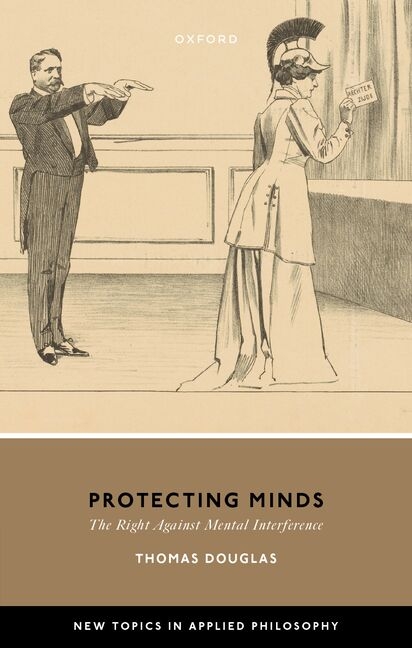
Protecting Minds: The Right Against Mental Interference - Hardcover
$109.99
Quantity
01
Pay over time for orders over $35.00 with
Offers & Perks
Earn 109 points with this purchase
Added to your rewards balance after checkout.
100 points welcome bonus
Create an account and start with extra points.
Availability:In StockContributor:Thomas DouglasSeries:New Topics in Applied PhilosophyPublish date:5/19/2026Pages:192
Languages:EnglishPublisher:Oxford University PressISBN-13:9780192883254ISBN-10:0192883259UPC:9780192883254Book Category:Philosophy, Political ScienceBook Subcategory:Ethics & Moral Philosophy, Political, Human RightsSize:8.58 x 5.82 x 0.71 inchesWeight:0.377Product ID:SC408113VC
It is widely accepted that we each possess a right against interference with our bodies. In this book, Thomas Douglas argues that we also possess an analogous right against interference with our minds. He defends the existence of this right--both by appealing to intuitions regarding cases and by invoking the notion of self-ownership--and he describes its content and contours. In Douglas' view, the right against mental interference protects us against actions that significantly alter our mental states and operate via processes that are insensitive to the reasons that bear on the mental alteration. The interventions that most obviously infringe the right are 'nonconsensual neurointerventions'--interventions that alter a person's mental states by physically modulating their brain states, and are performed without the target's consent. But Douglas argues that some psychological forms of influence can infringe the right too. Examples include the use of subliminal imagery and conditioning-based interventions, such as the use of loot boxes in computer games. This book contributes both to the increasingly vigorous debate over 'neurorights' and to the wider discussion of the ethics of mental and behavioural influence. Such discussion has traditionally treated manipulation, coercion and persuasion as the most important categories of influence; this volume introduces mental interference as a further category warranting attention. An open access title available under the terms of a CC BY-NC-ND 4.0 licence.
Languages:EnglishPublisher:Oxford University PressISBN-13:9780192883254ISBN-10:0192883259UPC:9780192883254Book Category:Philosophy, Political ScienceBook Subcategory:Ethics & Moral Philosophy, Political, Human RightsSize:8.58 x 5.82 x 0.71 inchesWeight:0.377Product ID:SC408113VC
Thomas Douglas, Professor of Applied Philosophy, Uehiro Oxford Institute, University of Oxford, and Senior Research Fellow, Jesus College, Oxford. Thomas Doulas is Professor of Applied Philosophy and Director of Research at the Uehiro Oxford Institute, University of Oxford. He trained in clinical medicine (Otago) and philosophy (Oxford) and works chiefly in philosophical bioethics and neuroethics. His research has focussed especially on the ethics of using medical and neuroscientific technologies for non-therapeutic purposes, such as cognitive and moral enhancement, crime prevention, and infectious disease control. He is the author of over 130 academic articles or chapters and has led two major externally funded research projects: 'Neurointerventions in Crime Prevention: An Ethical Analysis' (Wellcome Trust, 2013-2019) and 'Protecting Minds: The Right to Mental Integrity and the Ethics of Arational Influence' (European Research Council, 2020-2025).
Publisher: Oxford University Press
Contributor(s)
Author
Free shipping on orders over $75. Standard shipping takes 3-7 business days. Returns accepted within 30 days of purchase.