
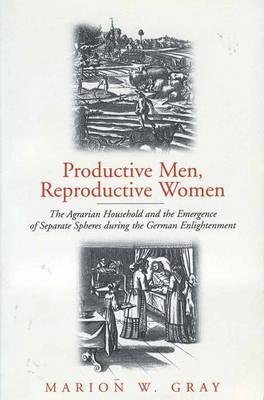
Productive Men and Reproductive Women: The Agrarian Household and the Emergence of Separate Spheres During the German Enlightenment - Paperback
Pay over time for orders over $35.00 with
Offers & Perks
Earn 36 points with this purchase
Added to your rewards balance after checkout.
100 points welcome bonus
Create an account and start with extra points.
The debate on the origins of modern gender norms continues unabated across the academic disciplines. This book adds an important and hitherto neglected dimension. Focusing on rural life and its values, the author argues that the modern ideal of separate spheres originated in the era of the Enlightenment. Prior to the eighteenth century, cultural norms prescribed active, interdependent economic roles for both women and men. Enlightenment economists transformed these gender paradigms as they postulated a market exchange system directed exclusively by men. By the early nineteenth century, the emerging bourgeois value system affirmed the new civil society and the market place as exclusively male realms. These standards defined women's options largely as marriage and motherhood.
Marion W. Gray received his PhD from the University of Wisconsin, Madison. He studied in Göttingen, was a visiting faculty member at Gießen, and has worked at the Max Planck Institute for History in Göttingen and the Arbeitsgruppe Ostelbische Gutsherrschaft in Potsdam. Formerly a faculty member in History and Women's Studies at Kansas State University, he is currently Professor and Chair of the Department of History at Western Michigan University.
Contributor(s)
Author
Free shipping on orders over $75. Standard shipping takes 3-7 business days. Eligible items may be returned within 30 days of delivery. Conditions apply.