
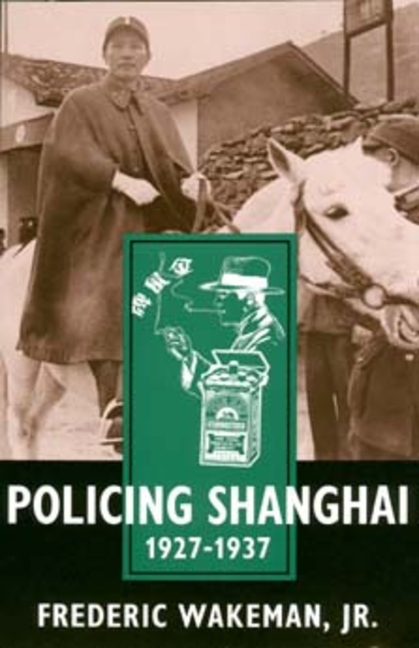
Policing Shanghai 1927-1937 - Paperback
$46.99
Quantity
01
Pay over time for orders over $35.00 with
Offers & Perks
Earn 46 points with this purchase
Added to your rewards balance after checkout.
100 points welcome bonus
Create an account and start with extra points.
Availability:In StockContributor:Frederic WakemanTheme:Cultural Region/Asian, Cultural Region/Chinese, Ethnic Orientation/AsianPublish date:11/6/1996Pages:478
Languages:EnglishPublisher:University of California PressISBN-13:9780520207615ISBN-10:0520207610UPC:9780520207615Book Category:HistoryBook Subcategory:AsiaBook Topic:ChinaSize:9.04 x 5.72 x 1.71 inchesWeight:0.813Product ID:SCS155VCT4
Prewar Shanghai: casinos, brothels, Green Gang racketeers, narcotics syndicates, gun-runners, underground Communist assassins, Comitern secret agents. Frederic Wakeman's masterful study of the most colorful and corrupt city in the world at the time provides a panoramic view of the confrontation and collaboration between the Nationalist secret police and the Shanghai underworld.
In detailing the life and politics of China's largest urban center during the Guomindang era, Wakeman covers an array of topics: the puritanical social controls implemented by the police; the regional differences that surfaced among Shanghai's Chinese, the influence of imperialism and Western-trained officials. Parts of this book read like a spy novel, with secret police, torture, assassination; and power struggles among the French, International Settlement, and Japanese consular police within Shanghai.
Chiang Kai-shek wanted to prove that the Chinese could rule Shanghai and the country by themselves, rather than be exploited and dominated by foreign powers. His efforts to reclaim the crime-ridden city failed, partly because of the outbreak of war with Japan in 1937, but also because the Nationalist police force was itself corrupted by the city.
Wakeman's exhaustively researched study is a major contribution to the study of the Nationalist regime and to modern Chinese urban history. It also shows that twentieth-century China has not been characterized by discontinuity, because autocratic government--whether Nationalist or Communist--has prevailed.
In detailing the life and politics of China's largest urban center during the Guomindang era, Wakeman covers an array of topics: the puritanical social controls implemented by the police; the regional differences that surfaced among Shanghai's Chinese, the influence of imperialism and Western-trained officials. Parts of this book read like a spy novel, with secret police, torture, assassination; and power struggles among the French, International Settlement, and Japanese consular police within Shanghai.
Chiang Kai-shek wanted to prove that the Chinese could rule Shanghai and the country by themselves, rather than be exploited and dominated by foreign powers. His efforts to reclaim the crime-ridden city failed, partly because of the outbreak of war with Japan in 1937, but also because the Nationalist police force was itself corrupted by the city.
Wakeman's exhaustively researched study is a major contribution to the study of the Nationalist regime and to modern Chinese urban history. It also shows that twentieth-century China has not been characterized by discontinuity, because autocratic government--whether Nationalist or Communist--has prevailed.
Languages:EnglishPublisher:University of California PressISBN-13:9780520207615ISBN-10:0520207610UPC:9780520207615Book Category:HistoryBook Subcategory:AsiaBook Topic:ChinaSize:9.04 x 5.72 x 1.71 inchesWeight:0.813Product ID:SCS155VCT4
Frederic Wakeman, Jr. is Haas Professor of Asian Studies and Director of the Institute of East Asian Studies at the University of California, Berkeley. He is the author of The Great Enterprise: The Manchu Reconstruction of Imperial Order in Seventeenth-Century China (California, 1985).
Publisher: University of California Press
Contributor(s)
Author
Free shipping on orders over $75. Standard shipping takes 3-7 business days. Returns accepted within 30 days of purchase.