
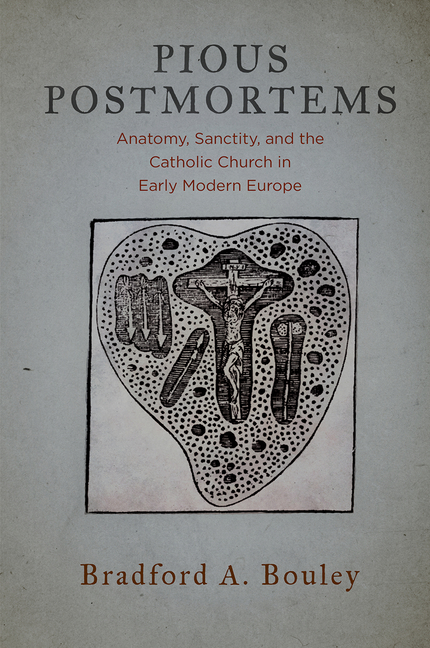
Pious Postmortems: Anatomy, Sanctity, and the Catholic Church in Early Modern Europe - Hardcover
Pay over time for orders over $35.00 with
Offers & Perks
Earn 73 points with this purchase
Added to your rewards balance after checkout.
100 points welcome bonus
Create an account and start with extra points.
As part of the process of consideration for sainthood, the body of Filippo Neri, "the apostle of Rome," was dissected shortly after he died in 1595. The finest doctors of the papal court were brought in to ensure that the procedure was completed with the utmost care. These physicians found that Neri exhibited a most unusual anatomy. His fourth and fifth ribs had somehow been broken to make room for his strangely enormous and extraordinarily muscular heart. The physicians used this evidence to conclude that Neri had been touched by God, his enlarged heart a mark of his sanctity.
In Pious Postmortems, Bradford A. Bouley considers the dozens of examinations performed on reputedly holy corpses in the sixteenth and seventeenth centuries at the request of the Catholic Church. Contemporary theologians, physicians, and laymen believed that normal human bodies were anatomically different from those of both very holy and very sinful individuals. Attempting to demonstrate the reality of miracles in the bodies of its saints, the Church introduced expert testimony from medical practitioners and increased the role granted to university-trained physicians in the search for signs of sanctity such as incorruption. The practitioners and physicians engaged in these postmortem examinations to further their study of human anatomy and irregularity in nature, even if their judgments regarding the viability of the miraculous may have been compromised by political expediency. Tracing the complicated relationship between the Catholic Church and medicine, Bouley concludes that neither religious nor scientific truths were self-evident but rather negotiated through a complex array of local and broader interests.Contributor(s)
Author
Free shipping on orders over $75. Standard shipping takes 3-7 business days. Eligible items may be returned within 30 days of delivery. Conditions apply.