
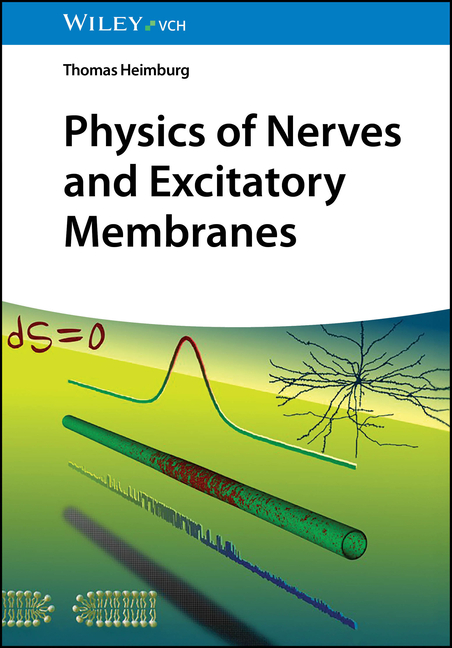
Physics of Nerves and Excitatory Membranes - Hardcover
Pay over time for orders over $35.00 with
Offers & Perks
Earn 120 points with this purchase
Added to your rewards balance after checkout.
100 points welcome bonus
Create an account and start with extra points.
Unique reference explaining how novel concepts in thermodynamics can explain the full range of nerve cell properties and functions
Physics of Nerves and Excitatory Membranes lays out a novel concept for the function of excitatory membranes, nerve cells, and the brain that is based on thermodynamics, demonstrating that the propagation of a nerve pulse, its temporal length, the occurrence of ion channel-like events in nerve membranes, and the action of anesthetics are all rooted in thermodynamic couplings and may be described using the fluctuation-dissipation theorem that is fundamental for thermodynamics. This new view of excitatory membranes differs significantly from the traditional electrophysiological description of nerves that largely neglects the mechanical, thermal, and chemical properties of nerve cells and their membranes and thus struggles to explain important neuronal properties such as the action of general anesthetics.
Physics of Nerves and Excitatory Membranes is didactically written and includes information on:
- The structure and electrical properties of nerves, dimensions and mechanical properties of the nerve pulse, and optical changes during the action potential
- Cable theory, voltage gating, the Hodgkin-Huxley model, and protein ion channels
- Membrane structure and melting, phase behavior, domains, and rafts, and the influence of voltage, drugs, proteins, pH, and ionic strength
- Heat capacity, sound propagation, relaxation timescales, and capacitance and capacitive susceptibility
- Voltage-gated and mechanosensitive lipid channels, temperature sensing, and selectivity of lipid channels
Physics of Nerves and Excitatory Membranes is of prime interest for biophysicists studying biomembranes as well as for neurobiologists and clinical researchers studying anesthesia. Its accessible style makes it very well suited for teaching the subjects that it covers.
Thomas Heimburg is Professor for Biophysics at the Niels Bohr Institute of the University of Copenhagen (Denmark), where he is the head of the Membrane Biophysics Group. His research focuses on theoretical and experimental thermodynamics of biological systems, including biomembranes, artificial lipid membranes, and proteins. He is the author of the book Thermal Biophysics of Membranes (Wiley-VCH, 2007).
Contributor(s)
Author
Free shipping on orders over $75. Standard shipping takes 3-7 business days. Returns accepted within 30 days of purchase.