
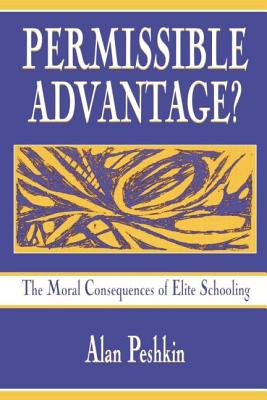
Permissible Advantage?: The Moral Consequences of Elite Schooling - Paperback
by Alan Peshkin
$60.99
Choose Option
Paperback
$60.99

Hardcover
$231.99
$233.99
Quantity
01
Pay over time for orders over $35.00 with
Offers & Perks
Earn 60 points with this purchase
Added to your rewards balance after checkout.
100 points welcome bonus
Create an account and start with extra points.
Availability:In StockContributor:Alan PeshkinSeries:Sociocultural, Political, and Historical Studies in EducatioPublish date:8/1/2000Pages:152
Languages:EnglishPublisher:RoutledgeISBN-13:9780805824674ISBN-10:0805824677UPC:9780805824674Book Category:Education, PhilosophyBook Subcategory:Educational Psychology, Philosophy, Theory & Social Aspects, Ethics & Moral PhilosophySize:8.96 x 5.97 x 0.42 inchesWeight:0.259Product ID:SCD1Y7M387
This study of Edgewood Academy--a private, elite college preparatory high school--examines what moral choices look like when they are made by the participants in an exceptionally wealthy school, and what the very existence of a privileged school indicates about American society. It extends Peshkin's ongoing exploration of U.S. high schools and their communities, each focused in a different sociocultural setting. In this particular inquiry, he began with two central questions:
* What is a school like whose students enter with a determined disposition to attend college, and all of whom are selected on the promise they display for college success?
* What can be learned from studying Edgewood Academy that transcends the particular case of this school? The volume opens with a description of how moral choices look when they are made by the participants in an exceedingly wealthy school. There is a general picture of the Academy, a discussion of the processes the school uses to insure the quality of its students and educators, and an overview of teachers and students that reveals what is commendable about each group. These chapters clarify what a school of ample financial means and wise leadership can do. Peshkin goes on to reflect briefly on privilege and concludes with a discussion of what the very existence of a privileged school indicates about American society. Schools, he suggests, are about much more than what goes on inside them--they mirror what is and is not at stake for their particular constituents--and function similarly for the nation. Edgewood Academy's host community is not a village, town, church, or tribe, as in Peshkin's previous studies. It is a community created by shared aspirations for high-level academic attainment and its associated benefits. Affluence and towering academic achievement are the two most relevant factors. In this book, advantage occupies center stage. The school's excellence is documented not to extol its success, but, rather, to call attention to what is available for its students that is not available for most American children. The focus, ultimately, is on educational justice as illuminated by the advantage of Academy students--that is, on justice denied, not because anyone or any group or agency consciously, planfully sets out to do injustice to other children, but because injustice happens as the artifact of imagined limitations of resources and means. Peshkin's purpose is not to detail the particulars of how educational justice is denied to the many, but to portray and examine the meaning of a privileged school where educational justice prevails for the few.
* What is a school like whose students enter with a determined disposition to attend college, and all of whom are selected on the promise they display for college success?
* What can be learned from studying Edgewood Academy that transcends the particular case of this school? The volume opens with a description of how moral choices look when they are made by the participants in an exceedingly wealthy school. There is a general picture of the Academy, a discussion of the processes the school uses to insure the quality of its students and educators, and an overview of teachers and students that reveals what is commendable about each group. These chapters clarify what a school of ample financial means and wise leadership can do. Peshkin goes on to reflect briefly on privilege and concludes with a discussion of what the very existence of a privileged school indicates about American society. Schools, he suggests, are about much more than what goes on inside them--they mirror what is and is not at stake for their particular constituents--and function similarly for the nation. Edgewood Academy's host community is not a village, town, church, or tribe, as in Peshkin's previous studies. It is a community created by shared aspirations for high-level academic attainment and its associated benefits. Affluence and towering academic achievement are the two most relevant factors. In this book, advantage occupies center stage. The school's excellence is documented not to extol its success, but, rather, to call attention to what is available for its students that is not available for most American children. The focus, ultimately, is on educational justice as illuminated by the advantage of Academy students--that is, on justice denied, not because anyone or any group or agency consciously, planfully sets out to do injustice to other children, but because injustice happens as the artifact of imagined limitations of resources and means. Peshkin's purpose is not to detail the particulars of how educational justice is denied to the many, but to portray and examine the meaning of a privileged school where educational justice prevails for the few.
Languages:EnglishPublisher:RoutledgeISBN-13:9780805824674ISBN-10:0805824677UPC:9780805824674Book Category:Education, PhilosophyBook Subcategory:Educational Psychology, Philosophy, Theory & Social Aspects, Ethics & Moral PhilosophySize:8.96 x 5.97 x 0.42 inchesWeight:0.259Product ID:SCD1Y7M387
Free shipping on orders over $75. Standard shipping takes 3-7 business days. Eligible items may be returned within 30 days of delivery. Conditions apply.