
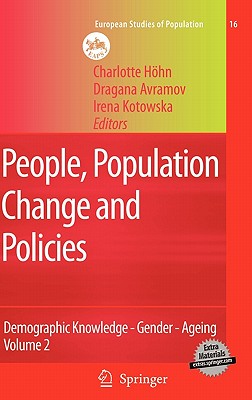
People, Population Change and Policies: Lessons from the Population Policy Acceptance Study Vol. 2: Demographic Knowledge - Gender - Ageing - Hardcover
$168.99
$169.99
-1%Quantity
01
Pay over time for orders over $35.00 with
Offers & Perks
Earn 168 points with this purchase
Added to your rewards balance after checkout.
100 points welcome bonus
Create an account and start with extra points.
Availability:In StockContributor:Dragana Avramov, Irena E. KotowskaSeries:European Studies of PopulationPublish date:3/18/2008Pages:347
Languages:EnglishPublisher:SpringerISBN-13:9781402066108ISBN-10:1402066104UPC:9781402066108Book Category:Social Science, Political ScienceBook Subcategory:Demography, Public Policy, SociologyBook Topic:Social PolicySize:9.30 x 6.10 x 0.80 inchesWeight:0.749Product ID:SC1K2F35JD
European countries, including the DIALOG countries, have faced a major de- graphic change and transition in the last thirty years. They are experiencing lo- term downward trends in fertility, leading to demographic ageing. Fertility rates are now below replacement level in nearly all countries. As a result, natural p- ulation growth rates are starting to decline, or population sizes are falling o- right. At the same time, the proportion of elderly dependants continues to grow while the working-age population declines in absolute and relative terms (see Kontula and Miettinen 2005). Moreover, net immigration, which potentially could offset declines in working-age population, remains generally low in most European countries (Grant et al. 2004). There are a great number of societal problems that arise from this demographic transition. The International Monetary Fund (2004) argues that the impact of - coming demographic changes on economical growth could be substantial. The h- toric association between demographicand macro-economicvariablessuggests that the projected increase in elderly dependency ratios and the projected decline in the share of the working-age population could result in slower per capita GDP growth, and lower saving and investment (IMF 2004, 147). For example, the estimates s- gest that demographic change could reduce annual real per capita GDP growth in 1 1 advanced countries by an average of / % point by 2050, i. e., growth would be / % 2 2 point lower than if the demographic structure had remained the same as in 2000 (IMF 2004, 147).
Languages:EnglishPublisher:SpringerISBN-13:9781402066108ISBN-10:1402066104UPC:9781402066108Book Category:Social Science, Political ScienceBook Subcategory:Demography, Public Policy, SociologyBook Topic:Social PolicySize:9.30 x 6.10 x 0.80 inchesWeight:0.749Product ID:SC1K2F35JD
Publisher: Springer
Edition
2008 Edition
Contributor(s)
Free shipping on orders over $75. Standard shipping takes 3-7 business days. Eligible items may be returned within 30 days of delivery. Conditions apply.